Combine:
- 1 C Miracle Whip
- 1/4 C Dijon mustard
- 1/4 C parsley (chopped)
- 2 TBL Crystal or Frank’s Red Hot Sauce
- 2 TBL lemon
- 2 TBL sugar
- 2 TBL scallions (chopped)
- 1 TBL mustard seed
- 2 tsp crushed black pepper
- 1 tsp salt
Feel free to browse.
Combine:
Not just freezing, but drying and preserving. This is intended only to give brief instructions. For details about why some of it is being done this way, check the internet.
This is intended only to give brief instructions. For details about why some of it is being done this way, check the internet.
Note that you are preserving flavor, but not texture. That is strawberries will be good in smoothies, jam or ice cream topping, but not as a munchable treat.
You should freeze fruits when they’re at their peak of freshness. Blanch fruits for 30 seconds first, then submerge in ice water to cool quickly. Dry thoroughly. Freeze for the first 12 hours on a rimmed baking tray, then move to heavy-weight, air-tight containers or freezer bags.
Rather than reinventing the wheel, the following text is from MyBluePrint.com.
Here’s your comprehensive guide to freezing all kinds of fruit.
Bananas are actually easy to freeze in a variety of ways. Choose extremely ripe bananas, as their flavor will preserve best.
Note: Berries can really benefit, texture-wise, from adding a little sugar before freezing. If desired, toss the berries with sugar (about 1/3 cup per pint) before pre-freezing.
Dried coconut can also be frozen: Simply place it in an airtight container and store for up to 6 months. No need to pre-freeze.
Learn more about dragonfruit in this post!
There are actually a few different methods of freezing eggplant. Here are two:
Two options here! The first is easier, in my opinion, but it’s totally up to you.
Note: Once defrosted grapes will have a different texture; however, I find their texture eaten straight from the freezer pleasant, as well.
Note: Check out our handy illustrated guide to how to cut a mango!
Tip: For an easy way to keep the passionfruit in small portions, spoon the fruit into an empty ice cube tray, and pre-freeze the portions in it. Transfer the frozen cubes of fruit to an airtight container before freezing.
Grandpa’s Note: Freestone offers the best results. Cut into quarters or eights, then slice the flesh from the skin. Freeze the skin and flesh separately, and use the skin for jellies or stocks, and the flesh for jams, marmalades and pies.
Learn how to de-seed a pomegranate here.
Note: Raisins and dried currants freeze beautifully, with minimal effect to their texture. To make your life easier later, divide into individual portions (or common amounts used in recipes).
This is intended only to give brief instructions. For details about why some of it is being done this way, check the internet.
Blanche all vegetables before freezing. Boil 60-90 seconds, plunge into water bath to stop the cooking process.
Chop into 3 inch pieces. Blanch 3-5 minutes depending on thickness. Will keep for up to 18 months. Good for soups, etc., but will not be crisp for a side.
Will keep for up to 18 months.
Cut into bite sized florets. Blance 3 minutes, then put into a large towel and toss to get as much water out as you can. Freeze the pieces whole in single-use zip lock bags. Good steamed or boiled (2 minutes) or in stir fries, quiches and soups. Broccoli will not have the crunch, but will taste OK. Use within a year.
Soak in heavily salted water for 30 minutes to encourage pests to vacate. Pick off any old leaves, and trim base off.
For cabbage: Quarter (leaving the stem intact) and freeze. Keeps only about six months.
For Brussels Sprouts: Blanche 3-5 minutes depending on the size. Move to freezer immediately on a rimmed cookie sheet. Freezing will actually improve the flavor, and they will keep about 18 months.
Don’t require blanching. Rinse well, dry and freeze. Will keep for up to 18 months. No longer good for salads, but good for soups, stews, braises, roasting, etc.
Freeze within 10 hours of being picked, not corn from the supermarket. Remove kernels from the cob. Blanche for 4 minutes. Freeze on a pre-cooled tray so kernels stay separate. Good for stir fry or on your plate. Will keep for up to 18 months.
These are best preserved by pickling. Read my collection here.
This can be dangerous. READ CAREFULLY. You can freeze peeled garlic in ice cube trays in olive oil, but DO NOT keep at room temperature for more than a few minutes. EVER. Botulism develops quickly. Go straight into the freezer, and then straight from the freezer to the pot or skillet and cook immediately. The bacterium Clostridium botulinum can cause death in a few days without medical treatment. It is safe only if you do it perfectly right.
Blanche, then freeze individual beans laid flat on a pre-cooled tray. Good for stir fry and soups. Will keep up to 18 months.
Freeze greens and whites separately. The greens freeze well without any processing. Blanch the whites for three minutes, and then freeze. Double bag to avoid onion smell in your freezer. Will keep for up to 6 months.
Do not blanche! Wipe them clean with a dry towel and cut off the end of the stem. Freeze individually on a tray overnight, then seal in a vacuum bag. Use within a year as you would fresh mushrooms.
Bake at 350°F for 45 minute, scrape out flesh and let cool and then puree. Freeze flat in zip lock bags.
Will keep for up to 18 months.
Blanche whole, then remove skin, cut into pieces, then freeze in zip lock bags that lay flat. Not good for salads, but good for sauces, soups, etc. Will keep for up to 18 months.
Good for bread, saute, grilling, muffins, pancakes, lasagna, frittata, pizza, quiche, and more … Cut into pieces and blanche 3 minutes. Pat dry and freeze in single-use zip lock bags.
Will keep for up to 18 months.
Rather than reinventing the wheel, the following text is from MyBluePrint.com.
Here’s your comprehensive guide to freezing all kinds of vegetables.
Note: Berries can really benefit, texture-wise, from adding a little sugar before freezing. If desired, toss the berries with sugar (about 1/3 cup per pint) before pre-freezing.
Note: A cucumber will absolutely lose its texture when frozen — it won’t have any crunch. Instead, consider making freezer pickles, which are said to retain crunch (here’s a recipe).
There are actually a few different methods of freezing eggplant. Here are two:
INGREDIENTS
STEP BY STEP
INGREDIENTS
STEP BY STEP
This recipe is from Jacques Pepin
INGREDIENTS
STEP BY STEP
RESTAURANT RECIPE
NewScanCook.com
OLD RECIPE
SWEDISH BREAKFAST HERRING
This is great for cold evenings.
Dress the Mushrooms
Several meat and noodle meals.
A Croque Monsieur (as it turns out) is just a fancy name for a ham sandwich. It translates literally as “Crunch Sir” and is essentially a single slice of ham along with a slice of Grüyere or Emmentaler cheese. Adding an egg on top makes it a Croque Madame. Sometimes chicken is substituted for the ham in a Croque Madame.
Prepare a very lightly fried egg, and place on top of the sandwich after Step 10. In this case, you will NOT cut them into finger-food sized pieces. You can also use shredded chicken at Step 3.
Serve ham egg, croque madame and tomatoes on a large plate
Shear Thinning Liquids
Non-Newtonian viscous shear thinning in ionic liquids We have studied the shear thinning of several protic and aprotic ionic liquids (ILs) by stress-controlled rheometry, which indicated that some ILs exist as liquid phase aggregates that can be disrupted or broken at high shear rates. Increasing the temperature shifted the onset of shear thinning to higher frequency and indicated that a smaller or less cohesive aggregate was formed. However, upon application of a sufficiently high temperature, the sample resumed the characteristics of a Newtonian fluid. (HOEt)2NH.AcOH was selected as an example of a protic ionic liquid (PIL) to probe concentration effects on liquid ordering. At water concentrations lower than one equivalent per PIL component pair, the viscosity rapidly decreased, although the onset frequency of shear thinning remained constant. The shear thinning and low viscosity regime remained until approximately 3–4 equivalents of water were added and the PIL behaved as a Newtonian fluid. The effect of water on the shear thinning of (HOEt)2NH.AcOH indicated that small dilution volumes did not alter the aggregate structure, but instead reduced the number of aggregates. Both the temperature and additive water strongly suggested that the IL aggregates were due to intermolecular hydrogen bond networks.
Shear Thickening Liquids
Shear induced self-thickening in chitosan-grafted polyacrylamide aqueous solution A remarkable shear induced self-thickening of chitosan-graft-polyacrylamide aqueous solution was observed. After the polyelectrolyte solution presenting shear thinning was subjected to a high-rate shear for several minutes, their viscosities recovered and then a much higher zero shear viscosity than the original one appeared. Obviously, the self-thickening differs from conventional shear thickening or viscous recovery, as reported previously. The mechanism of self-thickening was investigated by rheological methods together with TEM, 1H NMR and DLS, etc. It was found that some aggregates exist in original chitosan-graft-polyacrylamide aqueous solution and the scale of such aggregations would become larger within several minutes after a strong shear. The thickening was proven to be the result of an enhanced scale of GPAM aggregation in aqueous solution, and the mechanism of aggregation was proven to be intermolecular hydrogen bonding effects. Besides, the shear-induced self-thickening appears to be facile, maintainable and easily controllable by changing the shear conditions.
Rheology of Liquid Foods
Liquid foods are classified and their properties discussed under various types of rheological behavior: Newtonian, pseudoplastic, shear thickening, thixotropic, and viscoelastic. Rheological data on selected liquid foods are summarized in either tabular form or in the form of equations. Wherever possible the influence of temperature, constituents, and structure on the rheological behavior is detailed. Because many foods are suspensions, the measurement of flow properties of suspensions and factors influencing their rheological behavior are also covered. Finally, the relationship between the flow behavior and the sensory evaluation of mouth feel and viscosity is discussed.
BRISKET vs CORNED BEEF :: They are both from the front chest area of the cow near the bottom of the chest, but they are not the same thing.
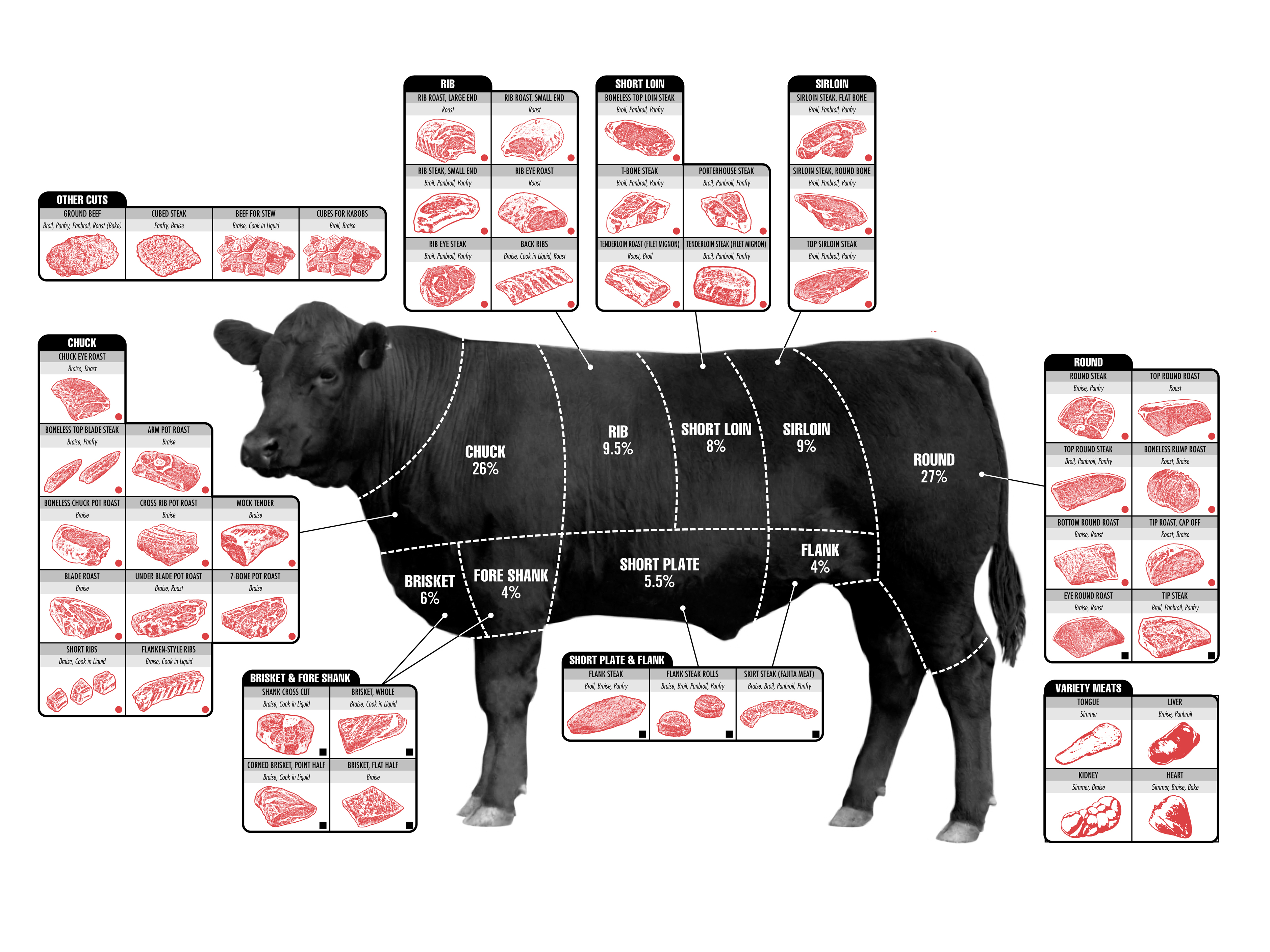
Fresh beef brisket is like a big roast. It refers to a cut of meat. The FLAT CUT is larger and leaner, which calls for a quick preparation. The POINT CUT is fattier and has more flavor. You should braise the point cut to allow for the breakdown of connective tissue. Trim some fat from each before preparing.
Corned beef frequently starts out as beef brisket and is brine-cured first. Corned beef refers to the curing/seasoning method, not the cut of meat.
Not all corned beef is brisket and certainly not all brisket is corned beef. Corned beef is usually cooked in a crock pot or dutch oven and the result is rather pink
Brisket Recipes
Corned Beef
The deli counter is full of pressing questions — because while you may have some vague understanding that pastrami and corned beef are two different things, and that one might be better than the other, you may be stuck on the how or why. Here are the major points of differentiation between the two, because no meat should ever be a mystery.
Pastrami and corned beef have different countries of origin: Pastrami has two possible ancestries: It’s either Romanian (where its predecessor, pastrama, was made with pork or mutton) or Turkish (where it’d be a descendent of pastirma, made with beef). Corned beef hails from Ireland, which is why it’s eaten on St. Patrick’s Day.
Pastrami and corned beef are different cuts of meat: Today’s corned beef and pastrami are both made from beef, albeit different parts of the animal. Corned beef is made from brisket, which comes from the lower chest of the cow; pastrami is either made from a cut called the deckle, a lean, wide, firm shoulder cut, or the navel, a smaller and juicier section right below the ribs. These days, you may also see pastrami made from brisket.
Pastrami and corned beef do have the same brine: Pastrami and corned beef are brined before they’re cooked; they’re either rubbed with or submerged in a solution of salt and spices to infuse the meat with more moisture and flavor. Both are brined in a mixture of salt, sugar, black pepper, cloves, coriander, bay leaves, juniper berries, and dill, as well as the preservatives sodium nitrate or sodium nitrite.
Pastrami and corned beef have different spice mixes: Here’s when things really start to differ. After brining, pastrami gets coated in a mixture of black pepper, coriander, mustard seeds, fennel seeds, and sometimes fresh garlic; that spice coating is what gives it its blackened appearance. Corned beef is… naked. No spice mix to speak of.
Pastrami and corned beef have different cooking methods: Pastrami is smoked over hardwood, oftentimes with a pan of water nearby, which helps create steam and keep the meat moist. It’s then cooled and then steamed before serving. Corned beef is… boiled. Sometimes with cabbage and other accoutrements in the mix, too.
Bonus round: If you’ve ever been to Montreal, you may be wondering: What does “smoked meat” have to do with all this? Smoked meat is a Canadian specialty that pulls from the same themes as corned beef and pastrami, but has a story arc of its own. It’s made with brisket and is brined in a mixture of black pepper, coriander, garlic, and mustard seeds — but with much less sugar than its pastrami and corned-beef cousins. It’s then smoked, like pastrami, and is best layered onto rye bread with mustard for serving — just like the rest of family.
Ingredients
See below for a laundry list of great garnishes
A gazpacho is a (usually) smooth (usually) cold (usually) vegetable soup. Basically you will blend your veggies, remove the foam, and then run through a food mill to make a very smooth soup.
Garnishes to be put on top at the discretion of the diner are almost a requirement. Below are some options for bowls of garnish.
Great Garnishes
This is good for fish, scallops, rare meat… many different main courses.
Ingredients
Plate the salsa, top with the protein and surround with cherry or compari tomatoes.