EZ Biscuits

  • 2 cups flour
  • One stick cold butter, cut into pieces.
  • 1 tablespoon baking powder
  • 1 teaspoon salt
  • 1 teaspoon sugar
    • Pulse until cold butter is no bigger than a pea
  • Blend in 1/2 cup chives
  • Three-quarter cup half-and-half or whole milk
  • Knead and roll to about a three-quarter inch thickness
  • Use two in biscuit cutter to cut out pieces
    • Do not twist biscuit cutter, or the biscuits will not rise.
  • Put on baking sheet
  • Egg wash with egg, white and a tablespoon of water
  • Bake 400° for 20 minutes

Easy 4 Ingredient Bread

From Sally’s Baking Addiction

Homemade Artisan Bread Recipe

5 Stars4 Stars3 Stars2 Stars1 Star4.8 from 1125 reviews
  • Author: Sally McKenney
  • Prep Time: 4 hours
  • Cook Time: 25 minutes
  • Total Time: 4 hours, 25 minutes
  • Yield: 2 8-inch loaves

Even if you’ve never made homemade bread or worked with yeast before, this homemade artisan bread is for you. Watch the video tutorial below and review the recipe instructions and recipe notes prior to beginning. If you’re new to working with yeast, reference my Baking with Yeast Guide for answers to common yeast FAQs.

Ingredients

  • 3 and 1/4 cups (about 430gbread flour (spooned & leveled), plus more for hands and pan
  • 2 teaspoons (about 6ginstant yeast
  • 2 teaspoons (about 9gcoarse salt (see note)
  • 1 and 1/2 cups (360ml) water, close to room temperature at about 70°F (21°C)
  • optional: cornmeal for dusting pan

Instructions

  1. In a large ungreased mixing bowl, whisk the flour, yeast, and salt together. Pour in the water and gently mix together with a silicone spatula or wooden spoon. The dough will seem dry and shaggy, but keep working it until all the flour is moistened. If needed, use your hands (as I do in the video tutorial below) to work the dough ingredients together. The dough will be sticky. Shape into a ball in the bowl as best you can.
  2. Keeping the dough in the bowl, cover the dough tightly with plastic wrap or aluminum foil and set on the counter at room temperature (honestly any normal room temperature is fine!). Allow to rise for 2-3 hours. The dough will just about double in size, stick to the sides of the bowl, and have a lot of air bubbles.
  3. You can continue with step 4 immediately, but for absolute best flavor and texture, I strongly recommend letting this risen dough rest in the refrigerator for at least 12 hours and up to 3 days. Place covered dough in the refrigerator for 12 hours – 3 days. I usually let it rest in the refrigerator for about 18 hours. The dough will puff up during this time, but may begin to deflate after 2 days. That’s fine and normal—nothing to worry about.
  4. Lightly dust a large nonstick baking sheet (with or without rims and make sure it’s nonstick) with flour and/or cornmeal. Turn the cold dough out onto a floured work surface. Using a sharp knife or bench scraper, cut dough in half. Some air bubbles will deflate as you work with it. Place dough halves on prepared baking sheet. Using floured hands, shape into 2 long loaves about 9×3 inches each (doesn’t have to be exact) about 3 inches apart. Loosely cover and allow to rest for 45 minutes. You will bake the dough on this prepared baking sheet.
  5. During this 45 minutes, preheat the oven to 475°F (246°C).
  6. When ready to bake, using a very sharp knife or bread lame (some even use kitchen shears), score the bread loaves with 3 slashes, about 1/2 inch deep. (“Score” = shallow cut.) If the shaped loaves flattened out during the 45 minutes, use floured hands to narrow them out along the sides again.
  7. Optional for a slightly crispier crust: After the oven is preheated and bread is scored, place a shallow metal or cast iron baking pan or skillet (I usually use a metal 9×13-inch baking pan) on the bottom oven rack. Carefully and quickly pour 3-4 cups of boiling water into it. Place the scored dough/baking pan on a higher rack and quickly shut the oven, trapping the steam inside. The steam helps create a crispier crust.
  8. Place the shaped and scored dough (on the flour/cornmeal dusted pan) in the preheated oven on the center rack. Bake for 20-25 minutes or until the crust is golden brown. Gently tap the loaves—if they sound hollow, the bread is done. For a more accurate test of doneness, the bread is done when an instant read thermometer inserted in the center reads 195°F (90°C).
  9. Remove the bread from the oven and allow to cool for at least 20 minutes before slicing and serving. Store leftovers loosely covered at room temperature for up to 5 days or in the refrigerator for up to 1 week.

Notes

    1. Make Ahead & Freezing Instructions: The dough can sit in the refrigerator for up to 3 days, so this is a wonderful recipe to begin ahead of time. You can also bake the bread, allow it to cool, and freeze for up to 3 months. Thaw at room temperature before serving. You can also freeze the dough. Complete the recipe through step 3. Wrap in plastic wrap and place in a freezer-friendly container. To bake, allow dough to thaw overnight in the refrigerator, or for 2-3 hours at room temperature. Continue with step 4 and the rest of the recipe instructions.
    1. Special Tools (affiliate links): Glass Mixing Bowls | Silicone Spatula or Wooden Spoon | Baking Sheets | 2-cup Measuring Cup | Bread Lame | Instant Read Thermometer
    2. Flour: For absolute best flavor and chewy texture, I strongly recommend using bread flour. You can use a 1:1 substitution of all-purpose flour in a pinch with no other changes to the recipe. I recommend avoiding whole wheat flour in this dough. If necessary, use half bread flour and half whole wheat flour. The bread will taste dense.
    3. Yeast: You can use instant or active dry yeast, but I highly recommend an instant (aka “rapid rise” or “quick rise” yeast). The bread will rise faster. I usually use Platinum yeast by Red Star, which is an instant yeast. 2 teaspoons is a little less than 1 standard packet. If using active dry yeast, there are no changes needed to the recipe. The rise time in step 2 may take longer.
    4. Salt: Use a coarse salt, such as coarse sea salt, in this bread. I find the flavor slightly lacking when using regular table fine salt. If you only have fine salt, reduce to 1 and 1/2 teaspoons.
  1. Water: Use cool water. 70°F (21°C) is great, but the exact temperature doesn’t matter as long as it’s not hot or warm.
  2. Round Loaf: If you want to shape the dough into a boule (round loaf) simply shape into a round ball instead of 2 loaves in step 4. Baking instructions are the same, but the loaf will take a few extra minutes in the oven. If you want to bake the boule in a dutch oven, see next note.
  3. Using a Dutch Oven: Follow this dough recipe through step 3, then follow the simple shaping/baking instructions (steps 2-5) in my Cranberry Nut No Knead Bread recipe including using the parchment paper. If your parchment paper can’t withstand heat this high, you can either lower the oven temperature and bake the bread for longer or grease the Dutch oven instead.
  4. Using a pizza stone: If you want to bake your bread loaves on a pizza stone, place pizza stone in the preheating oven. In step 8, place the shaped and scored dough on your preheated pizza stone. If the bottom of the shaped dough is pretty sticky, dust the hot pizza stone with some extra cornmeal. Bake as directed.
  5. No Nonstick Pan: If you don’t have a nonstick baking sheet, line it with parchment paper instead. Coat with a dusting of flour and/or cornmeal before placing the dough on top. Parchment paper can burn, so it’s best to check the box to see how much heat yours can tolerate. Lower your oven heat if necessary and bake the bread for longer until golden brown and when gently tapped, sound hollow.
  6. Flavor ideas: Before pouring in the water in step 1, add any of the following ingredients/combination of ingredients to the dry ingredients in the bowl: 4 cloves minced garlic + 3 Tablespoons chopped rosemary, 3 Tablespoons your favorite fresh herb (chopped), 1 cup your favorite shredded cheese, a diced jalapeño, 3/4 – 1 cup dried cranberries and/or chopped nuts, 2 teaspoons garlic powder, etc.
  7. Reference my Baking with Yeast Guide for answers to common yeast FAQs.
  8. Recipe adapted from King Arthur Flour & Red Star Yeast, similar method originally from Jim Lahey.

Homemade Artisanal Crackers

FROM SALLY’S BAKING ADDICTION

Homemade Artisan Crackers

5 Stars4 Stars3 Stars2 Stars1 Star4.7 from 219 reviews
  • Prep Time: 40 minutes
  • Cook Time: 12 minutes
  • Total Time: 1 hour, 20 minutes (includes cooling)
  • Yield: 75–80 crackers

Give snack time an upgrade with flavorful homemade artisan crackers. Crispy, salty, savory, and endlessly customizable, the simple dough comes together quickly and easily in one bowl from basic pantry ingredients. 

Ingredients

Crackers

  • 2 cups (250gall-purpose flour, plus more for kneading and rolling
  • 1 teaspoon granulated sugar
  • 1 teaspoon salt
  • 1/2 teaspoon onion powder
  • 1/4 tsp garlic powder 
  • 1 Tablespoon finely chopped fresh rosemary or other add-in (see Notes)*
  • 2/3 cup (160g/ml) water
  • 3 Tablespoons (41g/45ml) extra-virgin olive oil, plus more for brushing on top
  • flaky sea salt, for topping

Instructions

    1. In a large bowl, whisk together the flour, sugar, salt, onion powder, garlic powder, and rosemary (or other add-ins). Pour in the water and olive oil and stir with a wooden spoon or silicone spatula until the dough comes together in a clump.
    1. Turn the dough out onto a lightly floured work surface. Lightly flour your hands and the dough and knead it, sprinkling on a little more flour as you go, until it’s no longer sticking to your hands and you can shape it into a rough ball, about 1 to 2 minutes. Return the dough to the bowl and cover the bowl with plastic wrap. Let the dough rest for at least 10 minutes, and up to 1 hour at room temperature.
    2. Preheat the oven to 425°F (218°C) and line large silver baking sheets with parchment paper.
    3. Cut the dough in half. Keep one half of the dough covered while you work with the other half.
    4. On a lightly floured work surface with a lightly floured rolling pin, roll one half of the dough out into a rectangle. Roll the dough very thin—about 1/16th of an inch (1.5mm). If the dough keeps shrinking back as you try to roll it out, lightly cover it and let it rest for 5 minutes, then try again. (Don’t worry if it shrinks, that’s completely normal and expected.)
    5. Using a ruler and a pizza cutter, cut the dough into small rectangles about 3 x 1.5 inches in size. Carefully transfer the crackers to the prepared baking sheet(s).
    6. Repeat steps 5 and 6 with the second half of dough.
  1. Dock (poke holes in) the crackers several times with a fork. Brush with olive oil, then sprinkle with flaky sea salt (and everything bagel seasoning or sesame seeds, if making those varieties. Note that extra seasonings on top can sometimes fall off of the crackers when eating them).
  2. Bake until golden brown and crispy, about 9–12 minutes. To ensure even browning, rotate the baking sheet(s) halfway through baking.
  3. Let crackers cool completely on the baking sheet(s) set on a cooling rack. Crackers need several minutes of cooling before they taste crispy. They taste fantastic with hummus, crab dip or other dips, various cheeses, or serve with a cranberry pecan cheese ball.
  4. Store in an airtight container at room temperature in a dry place for up to 2 days. To re-crisp crackers, spread them on a baking sheet and bake at 350°F for 10 minutes. Cool completely before serving.

Notes

    1. Make Ahead & Instructions: These crackers taste best for up to 2 days after you make them. See step 11 for how to re-crisp them, if desired. You can freeze cooled crackers. Cover tightly and freeze up to 3 months. Thaw at room temperature. Re-crisp if needed (see step 11).
    2. Other Flavors/Add-Ins: Do not leave the crackers plain. You need a flavor in the dough. Instead of rosemary, try another favorite herb, or any of these team favorites:
      • Black Pepper & Thyme: 2 teaspoons freshly cracked black pepper (do not use pre-ground fine pepper) + 1 Tbsp finely chopped fresh thyme
      • Everything & Chives: 1 Tbsp everything bagel seasoning (plus more for sprinkling on top) + 1 Tbsp dried chives
      • Sesame Seed: 1 and 1/2 Tbsp sesame seeds (plus more for sprinkling on top)
  1. Gluten-Free Flour? We don’t recommend using gluten-free flour in this recipe. The test batches we tried with different brands of GF flour came out break-your-teeth hard. You’re better off looking for a cracker recipe that has been developed specifically to be gluten free.
  2. Whole Wheat Flour? Crackers made with whole wheat flour were also quite hard. If you want to use whole wheat flour, try using half all-purpose and half whole wheat. Expect a slightly dense, less crisp cracker.

Soft Dinner Rolls

From:  https://sallysbakingaddiction.com/

You only need 7 ingredients to make these dinner rolls. Flaky, soft, and buttery, these fresh dinner rolls outshine any main dish. If you’re a bread beginner, read this blog post to learn more about the yeast rolls recipe, including how to prep the rolls ahead of time. You can also reference my Baking with Yeast Guide for answers to common yeast FAQs. 

This recipe is brought to you in partnership with Red Star Yeast.

Overview: How to Make Homemade Dinner Rolls

  1. Make the dough. Continue below to learn more about this dough recipe.
  2. Knead the dough. Reference my How to Knead Dough video tutorial if you need extra help with this step.
  3. Cover the dough and let it rise. The dough rises in about 1-2 hours in a relatively warm environment.
  4. Punch down the dough to release the air and shape into rolls.
  5. Let the rolls rise for about 1 hour.
  6. Bake for 20-25 minutes until golden brown. If desired, brush the warm rolls with a little honey and melted butter for extra flavor.

Soft Dinner Rolls Require a Rich Dough

The crustier and chewier the bread, the less fat in the dough. This is known as a lean dough. The softer and richer the bread, the more fat in the dough. This is known as a rich dough. Unlike chewy homemade bagels, focaccia, ciabatta, and my artisan bread, soft dinner rolls require a rich dough. Unfortunately, this doesn’t mean that the dough is swimming in cash. Rather, “rich” correlates with the amount of fat. For example, this dough has milk, butter, and egg.

You need 7 ingredients total. They’re the same ingredients in my easy cinnamon rolls and homemade brioche, which are also rich doughs. (Though I use more sugar for sweeter cinnamon rolls, of course.)

  1. Milk: Liquid activates the yeast. For the softest dinner rolls, use whole milk. Nondairy or low fat milks work too, but whole milk produces phenomenal flavor and texture.
  2. Yeast: You can use active dry yeast or instant yeast. If using active dry yeast, the rise times will be a little longer. I recommend Platinum Yeast from Red Star, which is an instant yeast blended with natural dough improvers.
  3. Sugar: Sugar feeds the yeast, increases its activity, and tenderizes the dough.
  4. Egg: 1 egg provides structure and flavor.
  5. Butter: Butter promises a flavorful and soft dinner roll. Make sure it’s room temperature.
  6. Salt: You can’t make flavorful bread without salt!
  7. Flour: You can use all-purpose flour or bread flour in this recipe. All-purpose flour is convenient for most, but bread flour produces chewier dinner rolls. There are no other changes to the recipe if you use bread flour.

3 Success Tips

  1. Reference my Baking with Yeast Guide, which answers many common yeast FAQs.
  2. Make sure your yeast isn’t expired. Expiration date is on the package.
  3. Directly from the pros at Red StarYeast: Measuring flour correctly is key to avoiding a dense dough, which leads to heavy (not soft!) rolls. Spoon and level your flour, do not scoop it out of the package.

My final piece of advice? Don’t limit these rolls to suppertime. They’re welcome anywhere, with any meal, any time of day. Use for sliders, breakfast sandwiches, soaking up your favorite tomato sauce with slow cooker turkey meatballs, alongside salad, or dunking into a bowl of creamy chicken noodle soup. Above all, don’t doubt yourself because you, too, can become a bread baking pro.

Soft Dinner Rolls Recipe

5 Stars 4 Stars 3 Stars 2 Stars 1 Star 4.8 from 1046 reviews
  • Author: Sally McKenney
  • Prep Time: 3 hours, 25 minutes
  • Cook Time: 22 minutes
  • Total Time: 3 hours, 45 minutes
  • Yield: 14-16 rolls

Description

You only need 7 ingredients to make these dinner rolls. Flaky, soft, and buttery, these fresh dinner rolls outshine any main dish. See recipe notes for freezing and overnight instructions. You can also reference my Baking with Yeast Guide for answers to common yeast FAQs. This recipe is also in my cookbook, Sally’s Baking 101.


Ingredients

  • 1 cup (240ml) whole milk, warmed to about 110°F (43°C)
  • 2 and 1/4 teaspoons Platinum Yeast from Red Star instant yeast (1 standard packet)
  • 2 Tablespoons granulated sugar, divided
  • 1 large egg
  • 1/4 cup (4 Tbsp; 56g) unsalted butter, softened to room temperature and cut into 4 pieces
  • 1 teaspoon salt
  • 3 cups (390g) all-purpose flour or bread flour* (spooned & leveled)
  • optional topping: 2 Tablespoons (28g) melted unsalted butter mixed with 1 Tablespoon honey


Instructions

    1. Prepare the dough: Whisk the warm milk, yeast, and 1 Tablespoon of sugar together in the bowl of your stand mixer. Cover and allow to sit for 5 minutes. *If you do not own a stand mixer, you can do this in a large mixing bowl and in the next step, mix the dough together with a large wooden spoon/silicone spatula. It will take a bit of arm muscle. A hand mixer works, but the sticky dough repeatedly gets stuck in the beaters. Mixing by hand with a wooden spoon or silicone spatula is a better choice.*
    2. Add the remaining sugar, egg, butter, salt, and 1 cup flour. With a dough hook or paddle attachment, mix/beat on low speed for 30 seconds, scrape down the sides of the bowl with a silicone spatula, then add the remaining flour. Beat on medium speed until the dough comes together and pulls away from the sides of the bowl, about 2 minutes. If the dough seems too wet to a point where kneading (next step) would be impossible, beat in more flour 1 Tablespoon at a time until you have a workable dough, similar to the photos above. Dough should be soft and a little sticky, but still manageable to knead with lightly floured hands.
    1. Knead the dough: Keep the dough in the mixer and beat for an additional 5 full minutes, or knead by hand on a lightly floured surface for 5 full minutes. (If you’re new to bread-baking, my How to Knead Dough video tutorial can help here.) If the dough becomes too sticky during the kneading process, sprinkle 1 teaspoon of flour at a time on the dough or on the work surface/in the bowl to make a soft, slightly tacky dough. Do not add more flour than you need because you do not want a dry dough. After kneading, the dough should still feel a little soft. Poke it with your finger—if it slowly bounces back, your dough is ready to rise. You can also do a “windowpane test” to see if your dough has been kneaded long enough: tear off a small (roughly golfball-size) piece of dough and gently stretch it out until it’s thin enough for light to pass through it. Hold it up to a window or light. Does light pass through the stretched dough without the dough tearing first? If so, your dough has been kneaded long enough and is ready to rise. If not, keep kneading until it passes the windowpane test.
    2. 1st Rise: Lightly grease a large bowl with oil or nonstick spray. Place the dough in the bowl, turning it to coat all sides in the oil. Cover the bowl with aluminum foil, plastic wrap, or a clean kitchen towel. Allow the dough to rise in a relatively warm environment for 1-2 hours or until double in size. (I always let it rise on the counter. Takes about 2 hours. For a tiny reduction in rise time, see my answer to Where Should Dough Rise? in my Baking with Yeast Guide.)
    3. Grease a 9×13 inch baking pan or two 9-inch square or round baking pans. You can also bake the rolls in a cast iron skillet or on a lined baking sheet.*
    4. Shape the rolls: When the dough is ready, punch it down to release the air. Divide the dough into 14-16 equal pieces. (Just eyeball it– doesn’t need to be perfect!) A bench scraper is always helpful for cutting dough. Shape each piece into a smooth ball. Arrange in prepared baking pan.
    5. 2nd Rise: Cover shaped rolls with aluminum foil, plastic wrap, or a clean kitchen towel. Allow to rise until puffy, about 1 hour.
  1. Adjust oven rack to a lower position and preheat oven to 350°F (177°C). (It’s best to bake the rolls towards the bottom of the oven so the tops don’t burn.)
  2. Bake the rolls: Bake for 20-25 minutes or until golden brown on top, rotating the pan halfway through. If you notice the tops browning too quickly, loosely tent the pan with aluminum foil. Remove from the oven, brush with optional honey butter topping, and allow rolls to cool for a few minutes before serving.
  3. Cover leftover rolls tightly and store at room temperature for 2-3 days or in the refrigerator for up to 1 week.

Notes

    1. Freezing Instructions: Prepare recipe through step 6. Place shaped rolls in a greased baking pan, cover tightly, and freeze for up to 3 months. Once frozen, the dough balls won’t stick together anymore and you can place them in a freezer bag if needed. On the day you serve them, arrange the dough balls in a greased baking pan, cover tightly, then let them thaw and rise at room temperature for about 4-5 hours. Bake as directed. You can also freeze the baked dinner rolls. Allow them to cool completely, then freeze for up to 3 months. Thaw in the refrigerator or at room temperature, then reheat as desired. If reheating the whole pan, lightly cover and reheat in a 300°F (149°C) oven for about 10 minutes or until warm.
    2. Overnight Instructions: Prepare the recipe through step 6. Cover the shaped rolls tightly and refrigerate for up to about 15 hours. At least 3 hours before you need them the next day, remove the rolls from the refrigerator, keep covered, and allow to rise on the counter for about 1-2 hours before baking. Alternatively, you can let the dough have its 1st rise in the refrigerator overnight. Cover the dough tightly and place in the refrigerator for up to about 15 hours. Remove from the refrigerator and allow the dough to fully rise for 2 more hours. Continue with step 5.
    3. Special Tools (affiliate links): Electric Stand Mixer or Glass Mixing Bowl and Wooden SpoonSpatula | 9×13-inch Glass Baking Pan | Bench Scraper | Pastry Brush
    4. Baking Pan: I prefer baking the rolls in a glass 9×13 inch baking pan because I find they brown a little too quickly in metal. As long as you bake the rolls on a lower oven rack and keep your eye on them, any pan is great.
  1. Yeast: Platinum Yeast from Red Star is an instant yeast. You can use Red Star Yeast active dry yeast instead. Rise times will be slightly longer using active dry yeast. Reference my Baking with Yeast Guide for answers to common yeast FAQs.
  2. Flour: You can use all-purpose flour or bread flour. All-purpose flour is convenient for most, but bread flour produces chewier dinner rolls. The rolls are still soft and fluffy no matter which you use. Either flour is fine and there are no other changes to the recipe if you use one or the other.

Adapted from Homemade Bread Bowls and Honey Butter Rolls

Hawaiian Rolls


Hawaiian Sweet Bread–Style Dinner Rolls

Hawaiian Sweet Bread–Style Dinner Rolls

  • Makes 15 rolls
  • Cook Time = 4½ hours
    From its small-town roots in Hilo, Hawaii, King’s Hawaiian Sweet Bread has become a mainland favorite. This is our homemade dinner roll version that delivers the characteristic soft, sweet, feathery crumb. (For a sandwich loaf, see the recipe below.) King’s doesn’t use pineapple juice, but it is called for by a number of copycat recipes. We found it provides depth without adding fruitiness. Milk powder contributes to a loftier rise, making the crumb light and tender, and promotes deeper browning. The rolls are best the day of baking, but they keep for a day or two at room temperature and will hold for up to a week in the refrigerator. To rewarm, wrap in foil and place in a 350°F oven for about 10 minutes.

Tip

Don’t use fresh pineapple juice, which contains bromelain, an enzyme that will affect gluten development. Pasteurized pineapple juice—whether canned, bottled or in a carton—has been heat-treated, which deactivates the bromelain.

Ingredients
  • 445 grams (3¼ cups) bread flour, plus more for dusting
  • 71 grams (⅓ cup) white sugar
  • 27 grams (¼ cup) nonfat or low-fat powdered milk
  • 2¼ teaspoons instant yeast
  • 1 teaspoon table salt
  • 6 ounce can (¾ cup) pasteurized pineapple juice
  • 57 grams (4 tablespoons) salted butter, melted and cooled slightly, plus more for the pan
  • 3 large eggs (1 egg separated)

Step 1

In the bowl of a stand mixer, whisk the flour, sugar, powdered milk, yeast and salt. In a 2-cup liquid measuring cup, whisk the pineapple juice, butter and the 2 whole eggs plus the third egg yolk. Attach the bowl and paddle attachment to the mixer. With the mixer running on medium-low, slowly add the pineapple-juice mixture, then mix until a webby, batter-like dough forms, about 3 minutes.

Step 2

Swap the paddle attachment for the dough hook. Knead on medium, scraping the sides of the bowl and hook as needed, until smooth, shiny and extensible, 10 to 12 minutes; the dough should clear the sides of the bowl but stick to the bottom. It will be quite slack, not firm and bouncy. Gather the dough in the center. Cover and let rise at room temperature until doubled, about 2 hours. Meanwhile, brush a 9-by-13-inch metal baking pan or glass baking dish with melted butter.

Step 3

Flour the counter and turn the dough out onto it; dust the top with flour. Using a chef’s knife or bench scraper, divide into 15 portions, each about 60 grams (2 ounces). Dusting your hands with flour as needed, form a portion into a taut ball by rolling it against the counter in a circular motion under a cupped hand, then pinch the seam on the bottom. Place seam side down in the prepared pan, about ¼ inch from the corner. Repeat with the remaining portions, placing the dough balls in 5 rows of 3. Cover loosely with a kitchen towel. Let rise at room temperature until doubled and the rolls are touching, about 2 hours.

Step 4

About 1½ hours into rising, heat the oven to 350°F with a rack in the middle position. In a small bowl, whisk together the egg white and 1 tablespoon water; set aside. When the rolls are ready, gently brush the tops with egg white. Bake until the rolls are risen and deep golden brown, about 25 minutes. Cool in the pan on a wire rack for 10 minutes. Gently invert the rolls from the pan, then turn them upright. Serve warm or at room temperature.

Step 5

Hawaiian Sweet Bread–Style Sandwich Loaf: Make the dough and let rise as directed. While the dough is rising, brush a 9-by-5-inch loaf pan with melted butter. Flour the counter and turn the dough out onto it. With floured hands, gently pat the dough into a 9-by-12-inch rectangle, with a short side facing you. Tightly roll the dough away from you into a 9-by-4½-inch cylinder. Turn the cylinder seam side down and place it in the prepared loaf pan. Cover loosely with plastic wrap and let rise at room temperature until the dough domes 1 to 1½ inches over the rim of the pan, about 2 hours. About 1½ hours into rising, heat the oven to 350°F with a rack in the middle position. In a small bowl, whisk the egg white with 1 tablespoon water. When the dough is ready, gently brush with egg white. Bake until risen and deep golden brown, 35 to 40 minutes. Cool in the pan on a wire rack for 10 minutes. Invert the bread onto the rack, then turn upright. Cool completely before slicing.


Fried Dumplings

CLICK HERE for YouTube video from Simple, Fast and Delicious

  • 1.25 C of water (300 ml)
  • 3/4 C flour ( 120 g )
  • 1/2 teaspoon salt
  • 1 tablespoon of butter or oil
  • 75 g feta cheese, gruyere, or mozzarella
  • some parsley some paprika
  • Other spices and fillings as desired
  1. Bring water up to a boil
  2. Add flour, salt and butter
  3. Stir till combined
  4. Continue to fold and knead over heat
  5. When springy, pinch off golfball-sized balls
  6. Flatten, and add filling
  7. Fold over, fixing edge with a fork
  8. Fry in peanut oil at 360º until browned

Things to know about Bread

This information from BetterReport.com
Visit that site if you want details about these tips.

It’s Made with 100% Whole Grains

Packaging should clearly say that the bread is “100% whole wheat.”

It Contains at Least 3 Grams of Protein

When grains are not processed, they keep all three layers of the plant: the endosperm, bran, and germ. But in refining flour, the bran and the germ are removed, taking away the highest concentrations of protein found in the grains.

It Has at Least 2 Grams of Fiber Per Slice

You should consume 25 to 30 grams of fiber daily as part of a balanced diet.

It Has a Moderate Amount of Sodium

Too much sodium can cause high blood pressure and dehydration, so look for a loaf with less than 160 mg of sodium per slice.

It’s Sourdough

The process results in a more easily digestible product, reduction of phytic acid content, improvement in nutritional value, and metabolic benefits through a lower glycemic index.

It Has a Short Ingredients List

A shorter list indicates a lack of additives and preservatives that may be found in less nutritious breads.

It Has Little to No Added Sugar

It Contains Nuts and Seeds

Healthy nuts and seeds can increase a bread’s nutritional value by being good sources of healthy unsaturated fats, fiber, protein, vitamins, minerals, and plant compounds.

Italian Rustic Bread

This is good for garlic bread.  SEE THIS RECIPE

      • PREPARE YOUR STARTER (aka BIGA)
    • Dissolve 1/2 tsp of yeast in 3 TBL warm water
    • Add just a pinch of sugar
    • Add 1 1/3 C room temp water
    • Add 1 C flour
      • Put on Kitchen Aid with paddle attachment
      • Mix to combine
      • Let rest 6-24 hours on counter – covered

The next day, you are ready to make your bread

    • Add 1 tsp yeast to your Kitchen Aid
    • Add 3 TBL warm water
    • Add just a pinch of sugar
      • Let rest for 5 minutes
    • Add 1 1/3 C room temperature water
      • Using WET HANDS pull out 6 oz (about 2/3 C) of your BIGA
    • Add that into your water
      • Whisk, squeeze or cut your BIGA into the water
    • Put paddle attachment onto your Kitchen Aid – While mixing . . .
      • Add 1 C AP flour and combine
      • Add 1 1/2 more C AP flour and combine
      • Add 1 C whole wheat flour
      • Add 2 tsp salt
    • Bring together using your Paddle attachment
      • It will be really sticky
    • Put dough hook onto the machine and run on high for 5-6 minutes
      • It will still be really sticky, but will start to show gluten development
    • Put onto a well-floured board and knead using a bench knife and your hands
    • Knead until it starts to get less sticky
    • Add flour to the board as necessary
    • Put into an oiled bowl allowing room for it to TRIPLE in size
      • Let rise 3-5 hours – the longer and cooler the rise, the better the results
    • On a lightly floured surface, pour dough out and form your loaves
    • Divide into two loaves
    • Gently roll toward you forming a roll, turn, the roll again, turn, then roll again
    • Form a round loaf on your board
    • Put parchment paper on your peel, and flour the surface
    • Put the dough on the peel, then spray very lightly with water
    • Cover and let rise again for about an hour
    • If it develops a skin, spritz it with water before going into the oven
    • Trim parchment to the edge of the loaf
    • Preheat baking stone to 450º
    • Sprinkle baking stone lightly with cornmeal
    • FLIP OVER, and put on baking stone – LEAVE parchment paper on loaf, for about 15 minutes
    • Carefully remove parchment, let it bake uncovered another 20 minutes or so
    • Do not cut until it has cooled.


Lox and Bagels

Homemade Lox

  • Sushi grade salmon
  • Mustard seeds, cumin seeds, corriander seeds
    • Toast briefly and grind together – set aside
  • Chop cilantro – set aside
  • Combine
    • 1 C kosher salt
    • 1 C brown sugar
    • Add 1/4 C tequila
  • Cover sheet tray with plastic sheet
  • Put salmon on the large sheet of plastic – skin side down
  • Brush salmon with chipotle puree
  • Sprinkle with dried spices
  • Put citrus zest on top
  • Put salt slurry on top
  • Wrap in plastic
  • Top with another pan and put a weight on top
  • Refrigerate 48-60 hours
  • Wipe seasoning off salmon
  • Slice as thinly as possible against the grain

Pickled Red Onions

  • Slice red onion in half, then slice thinly
  • Pickling Liquid
    • 1 C Red wine vinegar, lime juice or citric acid
    • 2 TBL sugar, whole mustard seeds, corriander
    • Black pepper corns and kosher salt
    • Bring to a boil, then turn off heat and let rest ( on burner 15 minutes )
  • Pour over onion and let rest 30 minutes
  • Transfer to mason jar and refrigerate
    • Pour liquid to cover onions

Goat Cheese Spread

    • Goat Cheese
    • Green Onion
    • Fresh dill
    • Salt and pepper
    • Splash of milk
    • Mix in food processor

Jalapeno Cream Cheese

    • Cream cheese
    • Fresh cilantro
    • Roasted jalapeno
    • Splash of milk
    • Mix with a fork


Basic English Muffins

THIS NEEDS TO BE TESTED AND EDITED

  • English Muffin Sketch – review
  • 12 oz ap flour
  • 1/4 oz active dry yeast
  • 1 TBL sugar
  • 1 tsp salt
  • 1.5 oz dried milk
  • Mix
  • – 10 oz water and 1 TBL shortening
  • Heat to 120-130º
  • Combine and Mix for 3 minutes
  • Will be gooey
  • Cover and let rise in fridge 12 hours
  • Punch down three times
  • Wipe rings and pan with crisco
  • Sprinkle inside of rings with cornmeal
  • Sprinkle on bottom of pan
  • Put into muffin rings (makes 8-10
  • Use 2 oz scoop into each ring
  • Top each with cornmeal or pulverized oatmeal
  • Rest 60-90 minutes
  • Cover with parchment and top with another pan
  • Bake at 400º for 15 minutes
  • remove parchment and pan
  • 5 more minutes or until internal temp is 195º
  • Cool 10 minutes
  • Offset spatula to remove

Thomas English Muffins

Close enough to Thomas

Grandpa’s Comments:

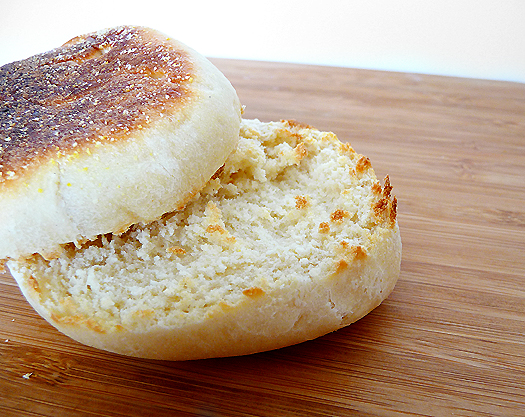
While not EXACTLY like Thomas’s English Muffins, these are close enough that I bought ten rings from Amazon and will not go back to the more expensive commercial product.  This recipe produces a slightly better muffin than the recipe above, but is a bit more work.


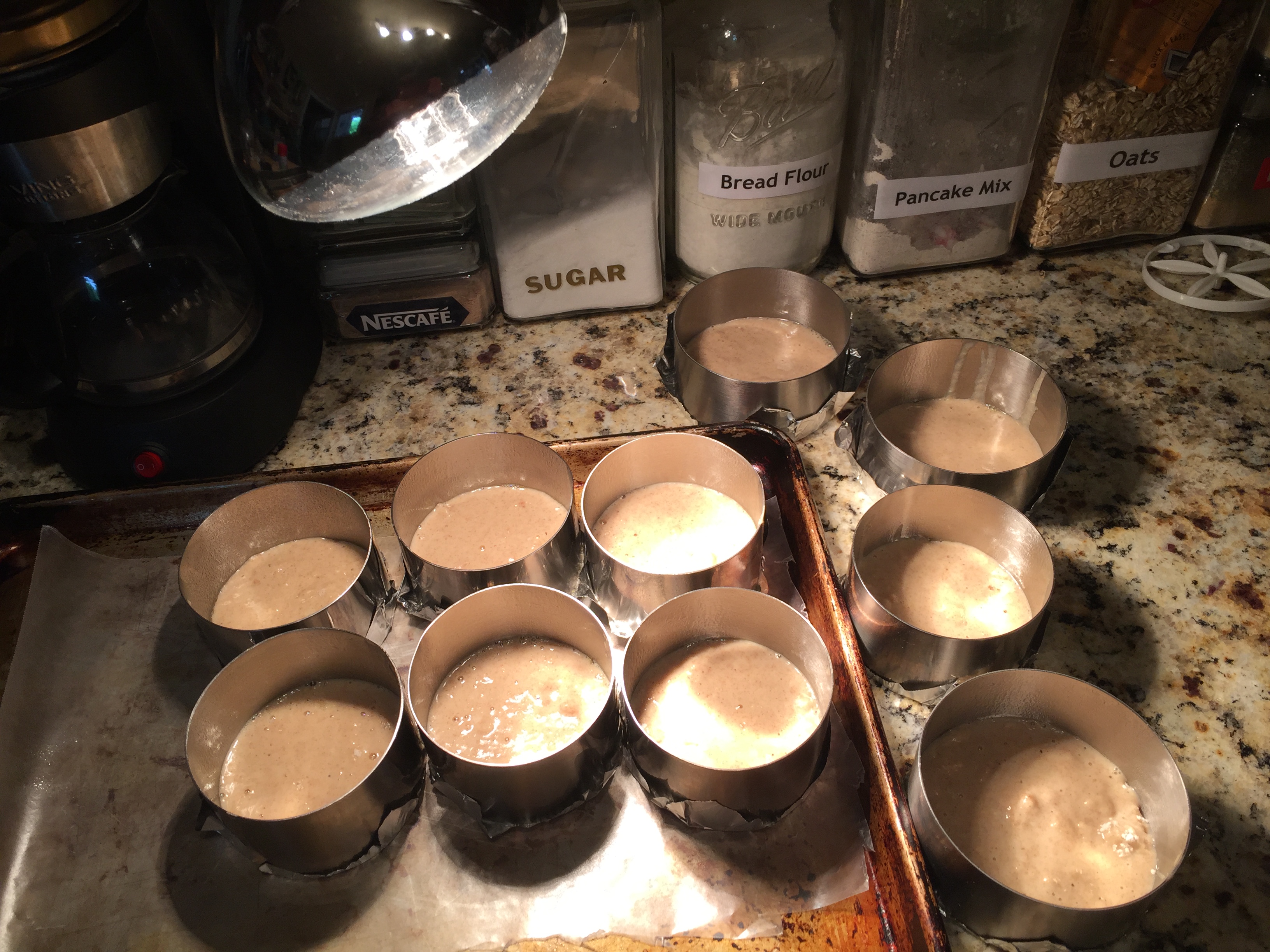
INGREDIENTS2016-04-05 09.24.20

  • FIRST MIX
    • 1/2 cup non-fat powdered milk
    • 1 tablespoon sugar
    • 3/4 teaspoon salt, divided
    • 1 tablespoon butter or shortening
    • 1 cup hot water – nearly boiling
  • SECOND MIX
    • 2 TBL dry yeast
    • 1 TBL sugar
    • 1/3 cup warm water
  • THIRD MIX
    • 1 C all-purpose flour – sifted
    • 1/2 C spelt flour – sifted
    • 1/2 C whole wheat flour – sifted
    • Non-stick vegetable spray and oil for brushing
    • 1 egg – beaten

STEP BY STEP

  1. FIRST MIX:  In a glass bowl combine the powdered milk, 1 tsp sugar, salt, shortening, and (nearly) boiling hot water; stir until the milk, sugar and salt are dissolved. Set aside to cool to 100 degrees or less
  2. SECOND MIX:  In a separate glass bowl combine the yeast and tablespoon of sugar in 1/3 cup of warm water and rest until yeast has dissolved. Let proof for 5 minutes.
  3. THIRD MIX:  After the milk mixture has cooled to 100 degrees or less, put it into your food processor or Kitchen Aid.  Add your beaten egg, and start adding your sifted flours about 1/2 cup at a time.  Beat until incorporated, then add more flour.  Your target is a soft wet dough.  Thicker than pancake batter, but not as thick as bread dough.
  4. Cover the bowl and let it rise in the fridge overnight.
  5. The following morning, use a 2 ounce ice cream scoop to put into your greased rings.  Let rise in a warm spot for 90 minutes (longer = more holes!).

We will be baking our muffins on a baking sheet in the oven.   If you don’t have muffin rings, try wide-mouth canning lids or mini-tart rings. And if you don’t have those, try using tuna cans with the top and bottom removed!

  1. A small square of foil underneath each ring makes it easier to transfer to the hot skillet. 
  2. Preheat the griddle to exactly 300 degrees. If you do not have an electric skillet, either get one or get an infrared thermometer at Thermoworks.com – This is where I got mine and I use it every single day. I cannot stress how critical temperature is in this recipe.
  3. Flip them onto an oiled skillet, and cook them with the foil on top until you are ready to turn them – then gently remove the foil
  4. COVER the skillet with its lid, and then cook for EXACTLY 5 minutes – they are easy to burn so set the timer.
  5. Use a tongs and remove the ring and the foil, then flip the muffin and cook for 5 more minutes.

ALTERNATELY BAKE IN THE OVEN AT 400º FOR 20-30 MINUTES.  Cover with parchment paper for the first 15 minutes.

Quick and Easy English Muffins

Quick and Easy English Muffins

As far as English Muffin recipes go, this one is pretty easy, and a good entry into the world of English Muffin making.  While not exactly quick (because of an overnight rise) this recipe is very easy.   As a bonus, it makes above average muffins with a long refrigerator life.

    • IN THE EVENING or LATE AFTERNOON
  1. In a four cup glass measuring cup, mix
    • 1 C whole milk and 1 C water
      •   Alternately, you can use 2 C lowfat milk.
    • 1 TBL sugar
    • 4 TBL butter
    • 1/2 tsp salt
  2. Heat in the microwave for three minutes.
  3. Pour into a large pot, and stir in eng_muffin
    • 1 C AP sifted flour (5 oz)
    • 1 C bread flour (5 oz)
  4. This will be like a thick slurry.  Heat until you start to see just a bit of steam rising from the surface of the milk mixture; then remove from heat and set aside to cool.
  5. When the slurry is still very warm, but not hot, combine and add
    • 2 TBL active dry yeast
    • 1 tsp sugar
    • 2 oz dried milk
  6. Meanwhile, if using Sourdough Starter, refresh your starter
  7. Cover and let both rise overnight
    • THE NEXT MORNING
  8. Mix in a large mixing bowl: 
    • 1 C sifted whole wheat flour (5 oz) and
    • 1/2 C flax (3 oz) or rye flour
  9. Put both risen sponges into your Kitchen Aid with the beater attachment and start on (setting 2) medium-slow speed
  10. Mix to combine, then add in 1 C of your new flour mixture
  11. Continue to add the flours in about 1/2 C at a time until you get kind of a wet gooey cookie batter – much thicker than pancake batter though, but not firm like a bread dough
  12. If it gets too dry, add a splash of milk
  13. Final ball should be moist to the touch, but not gooey or runny, and it should spring back if you press a finger into it.
  14. Cover, and let rise for about 1 1/2 hour
  15. Grease muffin rings
  16. Grease baking sheet
  17. Sprinkle rings and sheet with cornmeal
  18. Using an ice cream scoop, add the batter about half-way up each ring – 3/4 to 1 inch
  19. Sprinkle top lightly with cornmeal as well
  20. Meanwhile, bring a cast iron skillet up to about 325º
  21. Cook 1 side about 3-5 minutes, flip, remove ring, then 2-3 minutes.
  22. Alt:  Bake at 350º for 15 minutes, then remove ring and flip, then cook for an additional 8 minutes
  23. Cook – Internal temp should be between 185-200º   NEVER above 200º

Note: For crumpets, follow the above recipe, except increase milk from 1/2 C to 2/3 C, and cook only on one side, allowing bubbles to pop out the top.  At Step 13 (above) dough will actually be like a very thick pancake batter.

Sturdy Hamburger Bun

FULL INGREDIENTS: 508g All-purpose white flour 203g Russet potato (about 3 medium; baked, riced, cooled) 112g Unsalted butter 91g eggs 25g superfine white sugar 178g whole milk 61g water 11g fine sea salt 183g ripe levain (made with 61g ripe sourdough starter, 100% hydration, 61g AP white flour, 61g water; left to ferment for 3 hours at room temp) 🫙 EQUIPMENT 13×18″ plastic sheet pan covers: https://amzn.to/3uduy6s My favorite parchment paper: https://amzn.to/3OE6hhZ All my favorite baking tools: https://www.theperfectloaf.com/my-bak...


Soft Sourdough Potato Buns

  • Author: Maurizio Leo
  • Prep Time: 9 hours
  • Cook Time: 30 minutes
  • Total Time: 9 hours 30 minutes
  • Yield: 10 buns
  • Category: American

Description

These sourdough buns with added potato are the perfect hamburger bun. Extremely soft with enough strength and structure to support anything you might be grilling.


Ingredients


Levain

  • 61g all-purpose white flour
  • 61g water
  • 61g ripe sourdough starter

Main Dough

  • 447g all-purpose white flour
  • 203g potato, russet (about 3 medium; baked, riced, and cooled)
  • 112g butter, unsalted
  • 91g eggs
  • 25g caster sugar
  • 178g whole milk
  • 11g sea salt
  • 183g ripe levain

Egg Wash

  • 1 egg
  • 1 tablespoon whole milk

Topper

A mix of white and black sesame seeds, if desired.


Instructions

  1. Prepare levain and potatoes (8:00 a.m.)
    In a small bowl, mix and knead the Levain ingredients. Transfer to a small container, cover, and keep it at a warm temperature for 5 hours. Preheat the oven to 350°F (178°C) with a rack in the middle. Grab three or four potatoes that together weigh at least 300g or so — you will need a little extra to avoid coming in short (I baked 3 and had a little leftover) and scrub the skin clean under running water. Place the whole potatoes into a small roasting pan or dish and, with a fork, prick the skin around the potatoes several times to allow them to breathe during baking. Bake the potatoes for about 1 hour, flipping them halfway through. Remove them from the oven when a knife can easily slide into the center of the potato (internal temp of 208-211°F / 98-99°C). When baked, remove from the oven, skin them and rice them onto a baking sheet to cool.
  2. Mix (11:00 a.m.)
    To the bowl of a stand mixer fitted with the dough hook attachment, add all of the Main dough ingredients except the potato and butter (leave the butter at room temp to soften at this time). Turn the mixer to the lowest speed and mix until everything is incorporated. Scrape the sides of the bowl and dough hook and increase to speed 2, mix for 3-5 minutes until the dough begins to cling to the dough hook, and remove from the sides of the bowl. Then, scrape the hook clean, cover the mixing bowl, and let rest for 10 minutes. After the rest, mix on speed 2 for another 2-3 minutes until the dough again begins to cling to the hook. Next, add the room temperature butter, one pat at a time, while the mixer is set to low speed. Once all the butter is added, add half the riced potato and mix on low until incorporated. Then, add the remainder of the potato. Transfer the dough to a container for bulk fermentation.
  3. Bulk fermentation (11:15 a.m. to 2:30 p.m.)
    This dough will need 3 sets of stretches and folds during bulk fermentation where the first set starts after 30 minutes into bulk fermentation and the subsequent sets are at 30-minute intervals. After the third set of stretches and folds, let the dough rest, covered, for the remainder of bulk fermentation.
  4. Divide and shape (2:30 p.m.)
    To make shaping easier, place your bulk fermentation container into the fridge for 30 minutes. Line two baking sheets with parchment paper. After the dough is chilled, scrape the dough out to a floured work surface and divide into 120g potions. Using floured hands, flour the top of the dough pieces and shape them into tight balls. Place 5 on each baking sheet.
  5. Proof (2:45 p.m. to 5:15 p.m.)
    Cover the baking sheets with large reusable plastic and seal shut and proof for about 2 1/2 hours until the dough has puffed up considerably and is very soft to the touch.
  6. Bake (5:15 p.m., pre-heat oven at 4:45 p.m.)
    Preheat your oven to 450°F (232°C) with one rack at the bottom third and another at the top third. Make the egg wash: in a medium bowl whisk together one whole egg and 1 tablespoon of whole milk. Whisk until no lumps remain and the mixture is frothy. Uncover your baking sheets and, using a pastry brush, paint on an even layer of the egg wash. Liberally sprinkle on black and white sesame seeds, if desired. Bake the dough for 25-30 minutes until well colored. When baked, remove and let cool for 5 minutes on the sheets, then transfer to wire cooling racks. 


Homemade Hot Dog Buns

  • Author: Maurizio Leo
  • Prep Time: 6 hours
  • Cook Time: 35 minutes
  • Total Time: 6 hours 35 minutes
  • Yield: 10 hot dog buns
  • Cuisine: American

Description

Sturdy, light, airy, and absolutely delicious, these homemade sourdough hot dog buns will take your next hot dog to the next level.


Ingredients


Main dough

  • 398g medium-protein bread flour or all-purpose flour
  • 100g whole wheat flour
  • 274g water
  • 55g (one whole egg) egg
  • 50g butter, unsalted
  • 25g caster sugar
  • 9g fine sea salt
  • 139g ripe sourdough starter (100% hydration)

Egg wash

  • 1 whole egg
  • 1 tablespoon whole milk

Instructions

  1. Mix (9:00 a.m.)
    Cut the butter into 1/2″ pats and let warm to room temperature while mixing the ingredients. In the bowl of a stand mixer fitted with the dough hook attachment, add the water, flour, sourdough starter, egg, sugar, and salt. Mix on speed 1 for 1 to 2 minutes until the ingredients come together. Increase the mixer to speed 2 and mix for 4 to 5 minutes until the dough starts to strengthen and clump around the dough hook. Let the dough rest in the mixing bowl for 10 minutes. Turn the mixer on to speed 1 and add the room temperature butter, one pat at a time, waiting to add each pat until the previous one is fully absorbed. This is a fairly strong dough, so it won’t take long to add all the butter and the dough to come back together and smooth, somewhere around 3 to 5 minutes.
  2. Bulk fermentation (9:30 a.m. to 12:30 p.m.)
    Transfer the mixed dough to a bulk container and ferment for 3 hours at 75ºF (23°C). Perform 3 sets of stretch and folds at 30-minute intervals.
  3.  Chill dough (12:30 p.m. to 1:30 p.m.)
    Place the covered bulk fermentation container into the fridge for at least 1 hour to thoroughly chill.
  4. Divide and shape rolls (1:30 p.m.)
    Line a full sheet pan, or two half sheet pans, with parchment paper and set near your work surface. Divide the dough into ten pieces, each weighing 100g. Shape each into a tube about 4-inches long and place them on the prepared sheet pan with space between.
  5. Proof (1:45 p.m. to 3:45 p.m.)
    Cover the proofing dough with a large, airtight cover ensuring the cover doesn’t contact the dough (grease it with oil if necessary to prevent sticking). Let the dough proof at room temperature for two hours.
  6. Bake (3:45 p.m.)
    Preheat an empty oven with a rack in the bottom-third to 425°F (220°C). In a small bowl, whisk one whole egg and one tablespoon of whole milk for the egg wash. When the oven is preheated, uncover the dough and brush on a thin layer of the egg wash. Slide the sheet pan into the oven and bake for 20 minutes. After this time, rotate the pan back to front and reduce the oven temperature to 350°F (175°C). Bake for 10 minutes longer until the tops of the buns are golden brown, but the sides are still pale yellow. Once fully baked, remove the buns from the oven and cool them on a wire rack for 15 to 30 minutes before slicing. These buns are fantastic buttered and grilled before serving.


Doggo Bun for Hot Dogs

See full article at AZ Central.

This doggo dough can be made by hand or with a mixer. There is no shame or prestige in one over the other, though there is a satisfying learning opportunity in kneading a dough to the correct tenderness by hand.

Makes: 8 buns

Ingredients:

For the tangzhong starter:

  • 172 g (¾ cup) whole milk
  • 28 g unbleached bread flour

For the dough:

  • 600 g unbleached bread flour
  • 75 g granulated sugar
  • 12 g kosher salt
  • 18 g dry active yeast
  • 114 g butter, room temperature
  • 2 large eggs
  • 226 g (1 cup) whole milk, room temperature

For baking:

  • Baking tray
  • Parchment paper
  • 1 egg
  • 1 teaspoon water

Preparation:

  1. Working in a small sauce pot, whisk together the milk and flour for the Tangzhong until completely smooth.
  2. Cook over low heat while continuously stirring, until a paste thick enough to stick to the sides of the pot forms, approximately 3 minutes. Allow to cool slightly.
  3. In a large bowl, mix together the dough ingredients, starting with the dry ingredients, then incorporating the butter, followed by the eggs, then milk. Finally add the Tangzhong.
  4. Knead with either a mixer fitted with a dough hook or with the heel of your palm, either will produce the necessary kneading motion to stretch the dough and fold it over itself until a smooth elastic dough has formed.
    To test for correct gluten development, form the dough into a smooth ball, then gently press your thumb into the top. If the indentation remains, the dough is underworked. If the indentation bounces back most of the way, but retains a shallow dent, it is just right.
  5. Place the dough in a lightly oiled bowl and turn to coat. Cover and rest until the dough has puffed up nicely, about an hour or hour and a half. The dough will be proofed to the correct level when a slight poke into the dough holds its shape.
  6. Once proofed, turn out the dough on an unfloured surface (resist the urge to flour the working surface to prevent the dough from sticking. If needed, lightly oiling the hands will provide just enough oil to keep everything moving smoothly).
  7. Divide dough into 8 equal portions and form them into smooth balls. Then roll each one into an even 5 ½-inch cylinder, about the length of a hot dog.
  8. Line a baking tray with parchment paper. Place the dough cylinders on the tray abut a ½-inch  apart and flatten slightly.
  9. To proof, bring a small pot of water to a boil. Place the pot at the bottom of a cold oven. Place the bread tray on the center rack. Proof for approximately 50 minutes, or until noticeably poufy.
  10. Remove the bread tray from the oven and preheat to 350°F.
  11. Brush the tops of the buns with a wash consisting of 1 egg beaten well with 1 teaspoon water.
  12. Bake until the dough reaches an internal temperature of 190 F and is heavily fragrant, approximately 20 to 25 minutes.
  13. Cool the buns completely on a wire rack to prevent sogginess.
  14. Once cool, separate the buns and cut a slit into the side, keeping the ends together. Fill as desired.
  15. Store cooled buns in a paper bag for freshness.


Beatitudes Bad Banana Banana Bread

BISQUICK RECIPE AT THE BOTTOM OF THIS PAGE.

We’ve all bought bananas and had them go brown on the counter.  All is not lost.  Here is an easy recipe that Beatitudes Residents can use for those times.

INGREDIENTS FOR TWO SMALL LOAVES

FIRST BOWL:

  • 2 TBL softened margarine
  • 1/4 CU white granulated sugar
  • 1/4 CU brown sugar
  • 1 egg
  • 1/2 tsp vanilla
  • 2 TSP lemon juice
  • 1-2 over-ripe bananas – mashed

SECOND BOWL:

You can use these ingredients, or simply use 1 1/2 C Bisquick.  The recipe for Bisquick is at the bottom of this page, if you want to make your own.

  • 1 1/4 CU white flour
  • 1/2 tsp baking soda
  • 1 tsp baking powder
  • 1/4 CU softened margarine
  • 1/4 tsp salt
  • 1 tsp powdered ginger – or better yet 2 tsp grated ginger
    even better 1 TBL candied ginger
  • NOTE: I prefer to pulse the ginger with a bit of the sugar to make small chunks of ginger.

STEP BY STEP
1. Preheat oven to 300º F
2. IN FIRST (LARGE) BOWL – – Cream butter and sugars together
3. Add eggs, one at a time, beating until smooth after each egg
4. Mix in mashed bananas, vanilla, and lemon juice
5. IN SECOND BOWL sift and mix all dry ingredients together
(or just use Bisquick)
6. Add dry mixture to first bowl, stir to moisten. Do not over-mix.
7. Transfer to greased loaf pans (or pans lined with parchment paper)
8. Lay a sheet of foil or parchment paper loosely over the top, and bake 35 minutes.
9. Remove foil after baking 35 minutes
Increase heat to 350º and continue to bake for 15 more minutes.
10. Let stand ten minutes before removing from pan
11. Place released loaf on cake rack to cool
This will make TWO 2½ x 4½ baking dishes

Options:
1. Replace the ginger with chopped walnuts
2. Add raisins, dates, or dried cranberries rather (or in addition to) the ginger
3. We like to add ¼ C instant oatmeal to ours.

Ingredients for Making your own Bisquick

  • 4 cups all-purpose flour
  • 1 tablespoons baking powder
  • 1 tsp baking soda
  • 1/2 tablespoon salt
  • 1/2 cup butter – cubed

Step by Step

  1. Add everything except the butter into the bowl of a food processor.
  2. Pulse ingredients for about 15 seconds.
  3. Add in the vegetable shortening and pulse the processor until the mixture resembles cornmeal.
  4. Place homemade Bisquick into an airtight container and store within the refrigerator for up to 3 months.

Overnight Sourdough Cinnamon Rolls

Until the part where you roll the dough flat, this dough can be used for either breakfast cinnamon rolls, or nice soft dinner rolls.

INGREDIENTS

  1. DOUGH – Assemble ingredients
      • DRY INGREDIENTS
    • 3 C AP flour (350 gm by weight)
    • 1 tsp fine salt 
      • WET INGREDIENTS
    • 2/3 C whole milk – warm, not hot
    • 4 TBL butter – melted
    • 2 large egg
    • 1/2 C active sourdough starter
    • 1 TBL Instant Yeast or Quick Rise Yeast (Not Active Dry)
    • 2 TBL granulated sugar (yes, these are wet ingredients)
    • 2 TBL dried milk powder
  2. CinnaSugar FILLING – Assemble ingredients
    • 1/2 C CinnaSugar
    • 1/3 C more sugar
      • Or 1/2 C sugar, 1/4 C cinnamon, 1/2 tsp nutmeg
    • 1 TBL flour
    • 2 TBL softened butter
  3. GLAZE – Assemble ingredients
    1. 2 TBL butter – softened (not melted)
    2. 1/2 C whipped cream cheese – room temp
    3. 1/2 C confectioner sugar

STEP BY STEP

  1. Any time after 2 pm, prepare your dough
    1. Put the wet ingredients into your Kitchen Aid using the whisk attachment
    2. On low, add just over half of your dry ingredients
    3. Switch to your dough hook
    4. Continue to add dry ingredients about 1/2 C at a time
    5. Dough should be soft and slightly sticky. 
    6. Let rest for 30 minutes
    7. Knead on slow for about 8 minutes.  You are now looking for a dough that is soft, but not sticky.  Add bits of flour if dough is too sticky.
    8. Reclaim any unused flour.
    9. Let rise in the refrigerator overnight in a greased, covered glass bowl.  DO NOT keep in your metal bowl.
  2. The next morning, give the dough an hour to warm up just a bit.
  3. During this time, line a cake pan (round or square) with parchment paper on the bottom, and a thin ring of parchment around the sides.  Dabs of oil will help hold them in place.
  4. On a floured countertop, flatten the dough into a large square using your fingertips.
  5. Let the dough warm up for 10-15 minutes
  6. Sprinkle a bit of flour on top and roll your dough flat using a rolling pin.  Let is rest for 5 minutes if it starts to “spring back”
  7. Prepare your CinnaSugar filling.  Just combine and mix.
  8. Spread the filling on the dough, leaving a one inch border on one of the sides.
  9. With floured hands, carefully roll into a log, leaving the border so that it will be the last to be rolled.  Take your time and focus on making a tight roll.
  10. Wrap the entire roll tightly in plastic and refrigerate for 30 minutes.
  11. Remove the plastic and cut into 2 inch medallions.
    NOTE:  I like to put a mark in the middle, then marks either half way or 1/3 of the way so that all sections are similar width.
  12. Put the dough into your pan so that they are about 1/4 inch apart.
  13. Rest for 1-2 hours (second rise) before baking.
  14. Preheat oven to 350º
  15. Bake for 35-40 minutes.  Check every 3 minutes after 30 minutes have passed.  Take out when browned.
  16. Remove and let them cool for at least 15 minutes
  17. While it cools, prepare your icing
  18. Mix ingredients and whisk until smooth.  Use DROPS of milk to thin if necessary.
  19. Move rolls to a wire rack
  20. Top rolls with the glaze.  Optionally dust with cocoa powder.  Serve warm.


HTML Snippets Powered By : XYZScripts.com