Sandwich Bread Ingredients
You need 7 ingredients—practically the same as my homemade cinnamon swirl bread but less sugar. Likewise, they’re basically the same ingredients as my soft dinner rolls too, but in order to bake a bread that rises tall and has legitimate structure, we’ll leave out some of the fat. Swap some of the milk for water and leave out the egg.
- Water: Liquid activates yeast. I use mostly water in this dough because we need a bread that has structure. Using all milk, like I do for my dinner rolls, would yield a flimsy bread without much texture.
- Milk: To make a soft bread, you need fat in the dough so make sure 1/4 cup of the liquid is milk. Low fat milk works too, but whole milk produces phenomenal texture.
- Yeast: You can use active dry yeast or instant yeast. If using active dry, the rise times will be a bit longer. I recommend Platinum Yeast from Red Star, which is an instant yeast blended with natural dough improvers. It’s my go-to for all bread.
- Sugar: Sugar feeds the yeast, increases its activity, and tenderizes the dough.
- Butter: Butter promises a flavorful loaf. I tested this recipe with melted butter, softened butter, and even olive oil. We liked the loaf made with softened butter the best because it had pronounced buttery flavor and a softer (yet still sturdy) interior.
- Salt: You can’t make flavorful bread without salt!
- Flour: You can use all-purpose flour or bread flour. All-purpose flour is convenient for most, but bread flour produces a chewier crust. There are no other changes to the recipe if you use bread flour. For best taste, I highly recommend bread flour. It’s what I always use when I make artisan bread. If you wish to use whole wheat flour, follow my recipe for whole wheat bread instead.
Sandwich Bread
- Prep Time: 3 hours, 20 minutes
- Cook Time: 32 minutes
- Total Time: 4 hours
- Yield: 1 loaf
You only need 7 ingredients to make this simple sandwich bread. Soft and buttery with a chewy/crisp crust, this fresh loaf of bread will quickly become a staple in your kitchen. See recipe notes for freezing and overnight instructions. You can also reference my Baking with Yeast Guide for answers to common yeast FAQs.
Ingredients
-
- 1 cup (240ml) water, warmed to about 110°F (43°C)
- 1/4 cup (60ml) whole milk, warmed to about 110°F (43°C)
- 2 and 1/4 teaspoons (7g) Platinum Yeast from Red Star instant yeast (1 standard packet)
- 2 Tablespoons (25g) granulated sugar
- 4 Tablespoons (1/4 cup; 56g) unsalted butter, softened to room temperature
- 1 and 1/2 teaspoons (9g) salt
- 3 and 1/3 cups (about 420–430g) all-purpose flour or bread flour (spooned & leveled), plus more as needed
Instructions
-
- Prepare the dough: Whisk the warm water, warm milk, yeast, and sugar together in the bowl of your stand mixer fitted with a dough hook attachment. Cover and allow to sit for 5 minutes.
- Add the butter, salt, and 1 cup flour. Beat on low speed for 30 seconds, scrape down the sides of the bowl with a silicone spatula, then add another cup of flour. Beat on medium speed until relatively incorporated (there may still be chunks of butter). Add the remaining flour and beat on medium speed until the dough comes together and pulls away from the sides of the bowl, about 2 minutes. *If you do not own a mixer, you can mix this dough with a large wooden spoon or silicone spatula. It will take a bit of arm muscle!*
-
- Knead the dough: Keep the dough in the mixer and beat for an additional 5–8 full minutes, or knead by hand on a lightly floured surface for 5–8 full minutes. (If you’re new to bread-baking, my How to Knead Dough video tutorial can help here.) If the dough becomes too sticky during the kneading process, sprinkle 1 teaspoon of flour at a time on the dough or on the work surface/in the bowl to make a soft, slightly tacky dough. Do not add more flour than you need; you do not want a dry dough. After kneading, the dough should still feel a little soft. Poke it with your finger—if it slowly bounces back, your dough is ready to rise. You can also do a “windowpane test” to see if your dough has been kneaded long enough: tear off a small (roughly golfball-size) piece of dough and gently stretch it out until it’s thin enough for light to pass through it. Hold it up to a window or light. Does light pass through the stretched dough without the dough tearing first? If so, your dough has been kneaded long enough and is ready to rise. If not, keep kneading.
- 1st Rise: Lightly grease a large bowl with olive oil or nonstick spray. Place the dough in the bowl, turning it to coat all sides in the oil. Cover the bowl and allow the dough to rise in a relatively warm environment for 1-2 hours or until double in size. (I always let it rise on the counter. Takes about 2 hours. For a tiny reduction in rise time, see my answer to Where Should Dough Rise? in my Baking with Yeast Guide.)
- Grease a 9×5-inch loaf pan.
- Shape the bread: When the dough is ready, punch it down to release the air. Lightly flour a work surface, your hands, and a rolling pin. Roll the dough out into a large rectangle, about 8×15 inches. It does not have to be perfect—in fact, it will probably be rounded on the edges. That’s ok! Roll it up into an 8 inch log and place in the prepared loaf pan.
- 2nd Rise: Cover shaped loaf with aluminum foil, plastic wrap, or a clean kitchen towel. Allow to rise until it’s about 1 inch above the top of the loaf pan, about 1 hour. (See video and photo above for a visual.)
- Adjust oven rack to a lower position and preheat oven to 350°F (177°C). (It’s best to bake the bread towards the bottom of the oven so the top doesn’t burn.)
- Bake the bread: Bake for 32-36 minutes or until golden brown on top. If you notice the top browning too quickly, loosely tent the pan with aluminum foil. (I usually add aluminum foil over the loaf around the 20 minute mark.) To test for doneness, if you gently tap on the loaf, it should sound hollow. For a more accurate test, the bread is done when an instant-read thermometer reads the center of the loaf as 195–200°F (90–93°C).
- Remove from the oven and allow bread to cool for a few minutes in the pan on a cooling rack before removing the bread from the pan and slicing. Feel free to let it cool completely before slicing, too.
- Cover leftover bread tightly and store at room temperature for 6 days or in the refrigerator for up to 10 days.
Notes
-
- Freezing Instructions: Prepare recipe through step 6. Place shaped loaf in a greased 9×5-inch loaf pan or disposable loaf pan, cover tightly, and freeze for up to 3 months. On the day you serve it, let the loaf thaw and rise for about 4-5 hours at room temperature. Bake as directed. You can also freeze the baked bread loaf. Allow the bread to cool completely, then freeze for up to 3 months. Thaw in the refrigerator or at room temperature, then reheat as desired.
- Overnight Instructions: Prepare the recipe through step 6. Cover the shaped bread tightly and refrigerate for up to about 15 hours. At least 3 hours before you need the bread the next day, remove from the refrigerator, keep covered, and allow to rise on the counter for about 1-2 hours before baking. Alternatively, you can let the dough have its 1st rise in the refrigerator overnight. Cover the dough tightly and place in the refrigerator for up to 12 hours. Remove from the refrigerator and allow the dough to fully rise for 2 more hours. Continue with step 5.
- Special Tools (affiliate links): Electric Stand Mixer or Large Glass Mixing Bowl with Wooden Spoon / Silicone Spatula | 9×5-inch Loaf Pan | Rolling Pin
- Yeast: Platinum Yeast from Red Star is an instant yeast. Any instant yeast works. You can use active dry yeast instead. Rise times will be slightly longer using active dry yeast. Reference my Baking with Yeast Guide for answers to common yeast FAQs.
- Flour: You can use all-purpose flour or bread flour. All-purpose flour is convenient for most, but bread flour produces a chewier loaf of bread and I highly recommend it. The bread is still soft no matter which you use. Either flour is fine and there are no other changes to the recipe if you use one or the other. I don’t recommend whole wheat flour because it doesn’t have the same baking properties as white flour or bread flour (the gluten levels are different). If you wish to use whole wheat flour, try my recipe for whole wheat bread instead.
- Doubling this recipe: For best results, I recommend making two separate batches of dough. However, if you want to double the recipe all in 1 mixing bowl, double all of the ingredients except for the yeast and butter. Use 3 and 1/4 teaspoons yeast and 6 Tablespoons of butter.
- Bread Machine Questions: I don’t own a bread machine so I have not tested it, but some readers in the comments section have had success.
- Adapted from Homemade Cinnamon Swirl Bread
Find it online: https://sallysbakingaddiction.com/sandwich-bread/
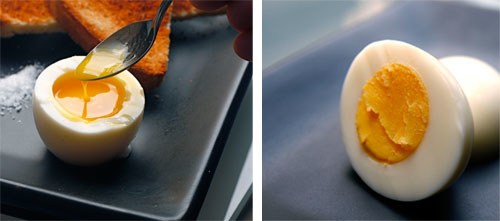
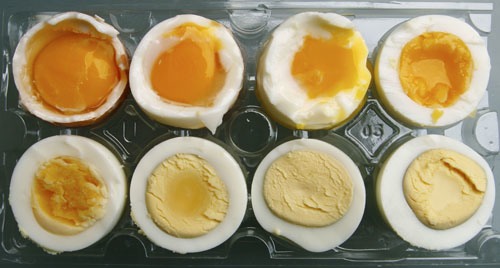
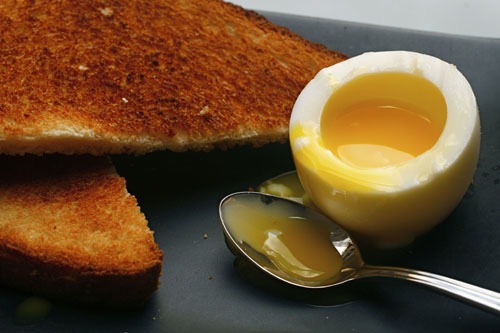
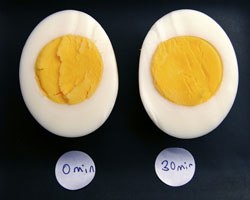 The best part about using this method is that even if you accidentally forget about your egg and leave it sitting in the water, there is no chance that it will overcook, because by the time the egg is done (about ten minutes), the water temperature has dropped far enough that the egg will stop cooking. These two eggs were cooked in the same pot of water—one was removed after 10 minutes, while the other was left for a full thirty. As you can see, they are both perfectly cooked.


Comments:
Seriously, all this reading on how to boil an egg? If you want a nice and creamy but firm yolk, put eggs in a small pot, just enough to cover the top. Bring to a boil. Once the water reaches a rolling boil, take the pot off the heat. Let it sit for 5 minutes for a firm/creamy yolk. 4 minutes for a runny yolk. 6minutes for a stiff but not overcooked yolk
Let us not forget, in this country of gigantic agri-farms and unfresh eggs, raw egg yolks can mean salmonella. Better only do soft-boiled eggs that’ll get you laid with farmers market products.
I wondered why I would get different results sometimes, as I use a 12 minute rest after it reaches a simmer, now I know it’s the size of the pan. Pretty fascinating how they were the same after 10 and 30 minutes.
Peeling can be tough, but back when I was doing tests at Cook’s Illustrated, I did one where we boiled 200 eggs and peeled them using various methods. Not a single one of them worked perfectly every time – some eggs just seem stubborn no matter what you do to them – but the most consistent method was to shock them in ice water immediately after cooking, then peeling them under cool running water.
Shocking them causes the whites to quickly contract, but since the shell walls are rigid, they don’t contract in the same way. So the white pull away from the walls slightly, making it easier to separate them. Running water helps because it runs in between the membrane and the white, also helping to separate it. Finally, start by peeling eggs at the fat end where the air pocket is. It gives you a good access point so you can get the first bits of shell off without having to harm the egg underneath.
When I was working at a restaurant many years ago where we sered soft boiled eggs on a dish (this was in the days before sous-vide makes it easy and foolproof to do), I used to cook at least twice as many as I needed, knowing that half of them would end up stuck to their shells and turn into family meal later in the day.
I am really impressed that you conducted all these trials in your apartment kitchen. It’s one thing to do this kind of thorough experimentation at Cook’s Illustrated where I imagine there are plenty of hungry bellies willing to make sure failed trials don’t go to waste, but to do this on your own requires either a limitless love for eggs or a steadfast commitment to sacrificing in the name of science. Did you get sick of egg salad and deviled eggs?
I put eggs in a small saucepan, cover with cold water and bring to a boil over medium high heat. When the water starts to bubble, I reduce the heat to a simmer and cook for 3-1/2 to 4 minutes. Then I drain, pour cool water over them to stop the cooking, quickly drain again and crack them open with the edge of a knife. Into a warmed bowl with a dab of butter, salt and pepper; toast on the side. Done.
6 minutes might be overcooked at a simmer, but these eggs are cooked at a sub-simmer. 180-degrees, when the water is barely quivering. It ensures that the exterior of the whites don’t get too tough, and six minutes really does work (especially if you have a thermometer and a timer)!
That said – of course, if you have a method that gives you eggs to your liking, there’s absolutely no reason to change anything about what you’re doing. Any method that gives you results you like is a good method!
Had a question – I tend to buy my eggs at the farmers market… as a result, they’re not refrigerated, making the internal temperature higher.
Have you done any tests with such an egg?
For a soft boil, saying they rest at around 68 degrees, would that cut my time in half?
How to “Peel” Hard-Boiled Eggs Without Peeling
I wouldn’t worry about the egg yolks. The salmonella in any egg is on the shell and comes from exposure to the hen’s digestive tract on its way out of the body via the cloaca. Add to that the fact that all of these cooking methods bring the yolk to at least 140 degrees and virtually all risk disappears
Wonderful article though, I really enjoyed reading the science of cooking eggs. And now I know why I’ve managed to undercook hard-boiled eggs before, apparently I used too much water in the pot.
Your visuals—especially the eggs sitting in a carton, cooked for increasing time periods—are fantastic! Thank you for this article. I look forward to reading more =)
Great article. Very informative. I’d really like to try out fancy-pants restaurant, slow-cooked egg method you mention. It must have been fantastic to work for Cook’s Illustrated!
Actually egg yolks can have salmonella if the hen’s ovaria is infected. Unlike egg white yolks don’t have lysozyme to kill bacteria, so they can grow inside yolks.
However, in agri-company mass produced eggs the possibility of salmonella-infected eggs are like 0.00001% (don’t remember exactly how many 0s), so you have to be pretty unlucky to get sick from eating runny yolk. I think nobody knows the % of infected eggs from small farms.
That article was eggsceptionally written. And the photo of the perfectly cooked egg with the liquid gold yolk and firm white was some seriously sexy food porn.
Thanks for the peeling tips. as a somewhat obsessed fan–only had 1 failed recipe from the ATK company in 4 years out of hundreds I’ve made–I get pretty much all of my info from the ATK knowledge bank and follow those peeling tips, as you said, sometimes it just doesn’t go as planned, and I also make a few extra, though my duds go to two very happy dogs.
I also have muscular dystrophy that affects my dexterity big time, and makes it hard for me not to throw difficult hard boiled eggs or potatoes I’m trying to peel across my kitchen at times!
I can picture your wife opening her lunch box saying “Eggs again! hopefully she has some good swap buddies where she works!”
How about your guys’ link: http://www.kjemi.uio.no/publikum/popularkjemi/egg/
why such a long article when it can be summed up in a flash app? scientifically researched and all?
I was hoping this article would address the green yolks I would get when I either overcooked the eggs or didn’t shock them immediately after cooking them.
Also, to the person who used to work at ATK — did you ever use the technique of blowing the egg out of its shell? It didn’t always work for me, but it was fun trying it out. Admittedly, I won’t use that technique if I’m making eggs for a public gathering.
One thing you didn’t analyze – supermarket eggs vs direct from farmer free range organic eggs. The eggs I use.
Shells on the supermarket eggs are much thinner than the eggs I use. That has some effect on heat transfer, but even more of an effect on peeling!
As a former scientist, I’m thrilled to see the detailed research that went into this – eggcellent job! I anxiously await your future hypotheses and methods.
This whole article articulates in such details on how to perfect the texture of the eggs. But it didn’t mention about a big factor – how to remove the sulfuric taste of the egg yolk!
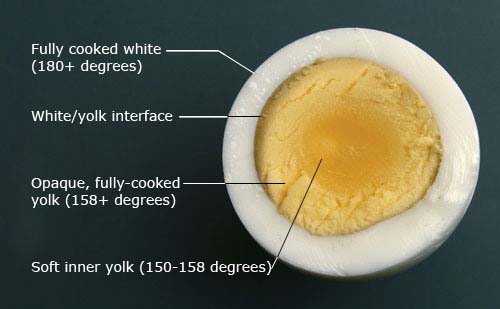
I watched Chef Pepin’s cookshow once he taught the audience an important trick: to poke a tiny hole at the broad end of the egg (using a push pin or similar) before boiling. With this you can effectively eliminate the sulfuric smell and taste of the egg yolk, and simultaneously remove the greyish green “rim” around the yolk (which you can see between the egg white and the egg yolk from the pictures above).
This method has work perfectly for me! And these small details are what make a perfect egg!
As the previous post alluded to, Chef Jacques Pepin’s simple method will always yield perfect hard boiled eggs without a rubbery white, or the dreaded black ring around the yolk. However, there is a little more to it.
Poking a tiny hole in the end with a push-pin allows the air pocket to escape, so the egg does not crack. What you also must do is shock the boiled eggs in ice water for several minutes. This forces the sulfer to pass though the shell by osmosis and escape.
This is THE recipe for perfect hard boiled eggs:
I’ve usualy done what salpico does – (Julia’s instructions, as I recall), but I’ve been having trouble lately getting the eggs to peel. I notice that he does as do I, and cracks the eggshells before submerging in ice water (and I’ve put a hole in the large end), whereas you seem to suggest that you let it shock in cold water before you crack it. Does this make a difference in whether the membrane pulls away?
lemonfair at 11:46AM on 10/11/09
So many great memories of soft-boiled egg on toast at the kitchen table on Saturday mornings. Thanks for the article! Got me all ramped up to bake some bread and boil some eggs. Damn my electric stove for temp control, but it still worked out pretty well.
Fantastic article. I just tried the method for hard boiled eggs and it was amazing. I didn’t know that my hard-cooked eggs could ever come out with a bright yellow, non-smelly, slightly creamy yolk and no green anywhere!
I may have to share this recipe with my mother. She’s going to ask me “What’s wrong with my eggs?!” until she tries it for herself, I’m sure of it.
Great article! I have always loved cooking shows that are educational in this manner. The incremental deviations were informative. I look forward to more!
Pepin suggests cracking the eggs before cooling, as opposed to afterwards. I have done it both ways, and don’t see a big difference.
The trick is to peel the eggs under running water, which makes it easier to separate the membrane and the shell from the egg.
We spent about 2 hours of our family vacation time in August discussing this very question, followed by heated back-and-forth e-mails after we returned home. The battle revolved around whether or not to put salt in the water, how long to cook, and whether to add the eggs to boiling water or not. We were all wrong, but as usual my mother was closest to the right answer.
re: farm fresh eggs vs. factory…it’s not the chicken poop on the egg that you have to worry about (although, yes wash it with a warm soapy scrubby) it’s the fact that mouse and rat poop get into the chicken feed at the factories (more bulk feeding, more feed laying around, more mice/rats to worry about) and then the chicken’s eating that causing the salmonella. When the feed is stored properly and chickens fed properly, this doesn’t happen nearly as much. Small farm chickens are usually healthier, usually getting sun and a variety of vegetable (grass, weeds) and meat (worms, bugs) products in their diet.
A healthier chicken means a healthier egg.
I think you should do part 2 of this in a high altitude location. I’ve been working on getting it right for about a year and a half now, and still don’t have a foolproof way. The again, I’m not nearly as scientific about it as you are.
In Jaque Pepin’s PBS techniques video he does and explains all this, even preventing the inner green color from appearing…wonderful and quite a few years old. And real simple to do and follow.
I just tried the soft-boiled per the above method with the water hitting 187F for 6 minutes … and they resembled something between the eggs above between 1 and 3 minutes. I pouted, tossed them down the disposal, and fried two more sunny-side up for dinner instead. If I could get a dedicated egg-shelling slave I’d be happy to do a high-altitude test.
Very nice! Geeky and cheesy…reminds me of my husband, who I adore.
I also like the systematic approach you’ve presented — especially the influence of the cooking water volume. Others have already mentioned possible variables that apparently weren’t considered (initial temperature of the egg, shell thickness, etc). Previous comments have brough up Pepin’s riff on boiled eggs. I remember him also saying that he sometimes gauges a restaurant by its ability to properly cook a HB egg (especially in terms of the dreaded green ring).
Confession time: fueled by a desire for a precise cooking method and innate laziness, sometime ago I bought a Krups egg cooker. They’re inexpensive and do a pretty darn good job at hard, soft and medium boiled eggs. Anybody else use one?
I find eggs much more likely to crack as a result of rapid change in temperature when taken straight from the fridge and added to boiling water. Adding salt draws out some of the liquid in the egg, so that it is less likely to crack.
Oddly, two factors that in my experience make a significant difference are not mentioned: height above sea level and weather (the higher and rainier, the lower the boiling point of water, and the longer it takes for eggs to set.)
When I was a brunch cook in Greenwich Village, peeling HB eggs was a snap. I shocked the eggs in ice water, then cracked the shell as I rolled the egg away from me. As the egg rolled the shell continued to crack away from the egg. Then I directed a stream of cold water underneath the shell to help separate egg from shell
I never cooked any egg unless it was at warm room temperature, they never ever stuck to a pan.
When I poached eggs I warmed them first in hot water to prevent the egg going everywhere. Lastly, before introducing an egg to the poaching pan, make a gentle whirlpool around where you intend to place the egg. This to give it shape. Then slide the egg in as close to the surface of the water as possible.
Sorry, but this is way to much info for a lonely egg. I just want to eat it, and frankly I don’t care if its not “perfect” and I doubt if I could even tell the difference.
Thank you, thank you! This was egg-citing to read because being a food nerd, I did always want to know egg-xactly how to boil the perfect egg. So thank you for shelling out this info!!!
Ah….why am I only now finding this site??? The first article I read is the best thing since my Food Science class in culinary AND I find that it references the chef I admire most! I am ova-ly eggstatic! This has been worth the hunt…Knowing the whys and hows only make us better at what we love doing most.
I tried but could not get the “perfect soft-cooked egg” by placing an egg taken straight from the fridge into 180F water, despite meticulously maintaining the water bath at eggsactly 180F for the six minutes the egg was immersed. The egg was considerably undercooked, with the whites fairly liquidy. I’m going to try egg-en.
I love this article! I’ve always thought I was an idiot since every time I boil eggs (I’m a hard boil-type), there is always something wrong with them. Now I know why! Soft boiled eggs look fascinating, but runny yolks gross me out big time.
We did an entire series on “how to eggs” back in July. From getting the basics down we moved the egg out of its normal breakfast role into dinner as well as methods were really fool proof, we tried and tried until, well, perfect! http://www.chezus.com/?s=incredible+egg&x=0&y=0
I’ve been doing it the way that Sara Moulton mentioned on her show many years ago – put the eggs in a saucepan covered with water. Bring it to a boil, not a hard boil. Turn off heat. Cover and let sit on a cold burner for a specific amount of time (I think she said 13 minutes but I do it for 16 minutes).
I find that if I crack them a bit and then refrigerate for awhile, they peel much easier.
So I am not really boiling per-say. This way I never over-boil, I never get a green line around the yolk, and I don’t get that horrid sulphur smell you get from over boiling. Works well every time for me.
I will beg to differ on the instructions given here.
You *can* have more control and reduce the variables involved in cooking your eggs. First of all, starting with cold eggs right out of the fridge is a mistake. You are maximizing the temperature difference between the egg’s starting temperature and its final temperature. You will have much more control if you warm the eggs first. I place them in a bath of hot tap water for 10 minutes while I heat my water.
Secondly, I place the eggs directly into boiling water. The reason I put the eggs directly into boiling water is that waiting for a boil is a “soft target”. What you consider a boil or a simmer could be as much as a minute different from someone else.
Lastly, I stop the cooking after a prescribed period of time by pouring off most of the hot water and replacing it with water and ice.
In summary: 1) I reduce the temperature change that will be required from the starting point of the egg to the end point of the process by warming the eggs up. 2) I avoid soft milestones by placing the eggs directly into boiling water at the beginning of the cooking process. 3) I stop the cooking (and improve the peel of the egg) by using an ice wash at the end.
BTW, if you want hot eggs, pull them out after only 10 or 15 seconds. The ice water will have already improved the peel by cooling the membrane and surface of the egg without cooling the inside of the egg. You can even peel the egg most of the time before the heat rebounds and makes the egg too hot to hold. A neat trick!
I love the scientific approach to the art of boiling an egg. However, I am surprised the author did not mention the temperature of the egg going into the water. Were his eggs right out of the refrigerator (I don’t thing so) or were they at room temperature? This is an important consideration and I am surprised that it wasn’t mentioned!
As a scientist, I’m glad that someone is starting a series focusing on this aspect of cooking. However, I would like to point out an inconsistency:
“when a mass is exposed to heat for a given period of time, a temperature gradient will form within that mass, with the area closest to the heat source being hottest, and the area furthest from the heat source being coolest. With very few exceptions, the temperature of a given spot in the food is proportional to the inverse square of its distance from the surface exposed to the heat source.”
If this were true, since the distance from the heat source at the surface of the egg is zero, this would imply that the surface of the egg has infinite temperature. I think you mean to say that the RATE of heat conduction depends on the distance from the heat source (as well as the temperature difference). Also, the rate of heat conduction is proportional to the inverse of the distance from the source, NOT the inverse squared (Newton’s law of cooling).
Awesome write-up, I disdain cooking but am a scientist at heart… First thing I did was cruise down to the kitchen to give it a shot. When doing HB (but also SB) are you putting/leaving the lid on? That significantly changes the rate of heat loss to the environment and can make a big change in the water temperature variation over time…?
Thanks for the correction, although I think the original statement is technically not inaccurate – the temperature I did say proportional, which is not to say that there are not constants involved (such as the temperature of the heat source) in the equation that takes care of the zero/infinity case.
Newton’s law of cooling only states that the rate of heat transfer is proportional to the temperature difference between the body and its surroundings – it doesn’t have anything to do the temperature gradient formed within a solid mass. To solve that, I think it helps to think of the egg as something like a russian doll – a series of solids. From there you can see that because of Newton’s law of cooling, the outer layers heat up at a much faster rate than the inner layers and that the differences in the rate at which the various layers are heating up is proportional to the distance, which means that the differences in the actual temperatures of the various layers are proportional to the inverse square of the distance.
I was doing it lid off – but like I said in the post, you can’t control for all the variables that might affect cooking time – your house might be a few degrees cooler than mine, or your stove might have a few more btu’s than mine. This article is meant more as a guide so that you know what aspects to consider when boiling an egg, and so that you understand the science behind it, and will thus be able to optimize cooking in your own particular environment. If that means putting on a lid to reduce the rate of heat loss, so be it!
Kenji,
The contradition I pointed out still stands no matter what constants are involved since any constant divided by zero is still infinity.
The rate of heating per area is proportional to the temperature difference and inversely proportional to the distance (this actually means that in the instant right after the cool egg is put in the boiling water, the rate of heat transfer to the outer surface of the egg is infinite; note that this is not a paradox since an infinite rate times an infinitely small time interval is still a finite amount of heat). The temperature itself is not inversely proportional to the distance (or the square of the distance); solving the rate equation, the temperature approaches that of the boiling water exponentially fast with time so that if you wait long enough the whole egg will be the same temperature as the bath. The distance to the heat bath appears only in the exponent, so that the closer to the bath, the faster the temperature changes.
yes, you’re right. I jumped the gun in my response there. I stand corrected.
But at the risk of putting my foot in my mouth again, I’m going to ask you another question: my immediate reaction is that your statement that the rate of heating is inversely proportional to the distance is not quite accurate, because it does not take into account the heat transfer coefficient of the egg. In a vacuum, yes, the rate of heating is proportional to only the distance, but an egg has mass, and so there is a coefficient involved, and that coefficient is proportional to thickness of the egg that the heat has to pass through, so does that not turn the equation into an exponential one instead of a linear one?
And one more question: are we losing the other SEers here? 🙂
p.s. All of this is starting to remind me why thermodynamics was my second least favorite class in college 🙂
I may have missed it, but I didn’t see any comments about baking “hard boiled” eggs. I didn’t think it would work when I saw the article, but just set the raw eggs on middle rack of a cold oven, (they recommend a little foil on the bottom of the oven in case one is cracked and breaks – never had it happen) set oven temp to 325, set timer to 30 min., when timer goes off, drop in very cold water. I’ve done it several times, worked perfect everytime. Tried pulling some out at 25 min., yolks were not completely set good enough for devilled eggs, but perfect for eating with a little salt and pepper. One complaint about this method is wasting electricity just for a few eggs. I had my potatoes wrapped in foil, some bread rolls rising, and some jalepeno poppers that I bake as an appetizer ready to go in at appropriate times once full temp was reached. Egg salad sandwiches, potato salad, some appetizers, and probably hashbrowns for breakfast in my future. What energy waste?
Kenji,
The heat transfer rate/area = (coefficient of thermal conductivity)*(T_bath-T_egg)/distance
The equation is the same regardless of the medium. The dependence on the medium comes from the thermal conductivity coefficient.
Also, I agree with you that we are the only two involved in this conversation right now 🙂
Kenji, if you’re still reading the comments on this…
“This is very similar to the gunk that seeps out of the surface of overcooked salmon.”
When you did the poached/steamed salmon on ATK, you had white gunk, but made a point to say that it didn’t mean the salmon was overcooked. Why the discrepancy? Was that a special case because of the cooking method?
Also, thanks for this and all of your articles on here. They’ve been great.
Thanks to SeriousEats convenient comment subscriptions, I get comments forwarded to my inbox, so yep. Still reading them.
As for the answer… em… because Cook’s Illustrated readers like their salmon more well-done than I do?
shh… don’t tell Chris!
In culinary school, they had very specific suggestions for cooking hard-boiled eggs to perfection.
1) Start with large eggs in a saucepot large enough to hold them in one layer, with cold water covering them by 1 inch. Toss in a tablespoon of cheap, white vinegar, which prevents the albumen (white part) from leaking out of the egg into the water.
2) With no lid on the pot, bring the eggs to a boil. Once at a boil, lower to a bare simmer and cook for exactly 11 minutes. This consistently produces perfect hard-boiled egg whites and yolks, lacking the unattractive, green ring of sulfur that can develop outside of the yolk from overcooking the egg.
3) Remove from the heat and place the pot in a sink under cold running water until the eggs are cool enough to handle. No ice bath should be used as the extreme change in temperatures will ruin the egg’s texture.
4) Peel and use as desired.
This… is… SCIENCE! I truly enjoyed this post, and it worked!!! 😀
As someone with a grad degree in Chem E (and more semesters than I want to admit of heat & mass transfer), I cringe at the statements regarding heat transfer above. “Temperature proportional to the inverse square of the distance”? Would that T be Celsius, Fahrenheit, or absolute? (No constant will fix that erroneous statement.) And the concept (when accurately stated) only applies strictly to an infinite body heated from one flat side. With a convergent field geometry (like, say, an egg!), that ‘truism’ goes out the window pretty quickly. I leave it to the interested reader to pick up any undergrad heat flow textbook to see what is really going on here.
…that said, it was a quite eggs-haustive study on cooking eggs, with lots of interesting detail. I wouldn’t have a clue how to cook a perfect soft egg otherwise (not that I feel success is guaranteed in my hands, even with the info above!).
@Dr. Moze – Thanks for the feedback, and sorry for the cringe. You are obviously correct. I should have written “energy,” not temperature, and yes, it doesn’t exactly apply to an egg, but I think the point is still the same: food cooks from the outside in, and it does not do it linearly. If you draw a radius vs. temperature graph of the an egg from the outside to the center after it has boiled for 5 minutes and started at fridge temperature, the graph will pretty closely resemble an inverse exponential (with the extremities cut off).
It’s not mathematically, or physically accurate, but for all intents and purposes, as far as cooking an egg goes, it’ll do – you’ll find that the thermodynamics errors make in your cooking are negligible compared to real-world things like the variations in the size of your egg, or how well ventilated your kitchen is, or even how unlucky you are. All you really need to know is that the outside will get very close to 212 way before the center even gets much above fridge temp.
Guess what I’m saying is that for those people interested in the nitty-gritty math, there are books out there that they can read (as you said), but for the rest of us, “pretty-darn-close”, or “close-enough-that-the-eggs-cook-good” is good enough!
(p.s. a bad semester of thermodynamics was the reason I dropped my biology major in college!)
This is a great article. I have a mania for measurement and controlled processes, yet still love cooking (it helps me learn to let go of the mania 🙂 ) but what this article does to me is makes me want a sous-vide set-up *even more*. Damn you Kenji!!
I always use the Julia Child method of hard boiling eggs and I’m able to get consistantly perfect eggs every time. There’s probably several ways to get perfect hard boiled eggs, but I’ve already got my method.
We did similar experiments and then created a fun website which will give you a youtube clip of the correct length of time it takes to boil your egg (just choose size, fridge or not and desired squidgyness).
Have a look at www.eggwatchers.com